


Reaction Disclaimer

Microbial electrosynthesis (MES) uses bacteria and electricity to convert CO2 into carbon-containing compounds, including organic acids. The technology thereby offers a promising approach for the more sustainable production of chemicals. The problem, for the time being, lies in recovering the products formed. ‘Using renewable electricity makes MES a sustainable method in principle,’ says biotechnologist Adrie Straathof of Delft University of Technology. ‘But if the downstream processing is subsequently not sustainable, you’re still not much better off.’
A team led by Straathof and fellow biotechnologist Ludovic Jourdin has now developed an integrated MES-adsorption-desorption-distillation system for the sustainable production of pure caproic acid, also known as hexanoic acid, from CO2. During downstream processing, the researchers recycled the remaining carboxylates formed by MES. In doing so, they achieved a yield of more than 99 per cent pure caproic acid. Caproic acid is industrially important for the manufacture of many products, including antimicrobial agents and ingredients for animal feed.
Straathof: ‘We are now demonstrating that the production of caproic acid is possible in a clean, carbon-neutral manner.’ Jourdin adds: ‘By integrating MES with selective recovery, we are advancing the technology further towards concrete applications.’
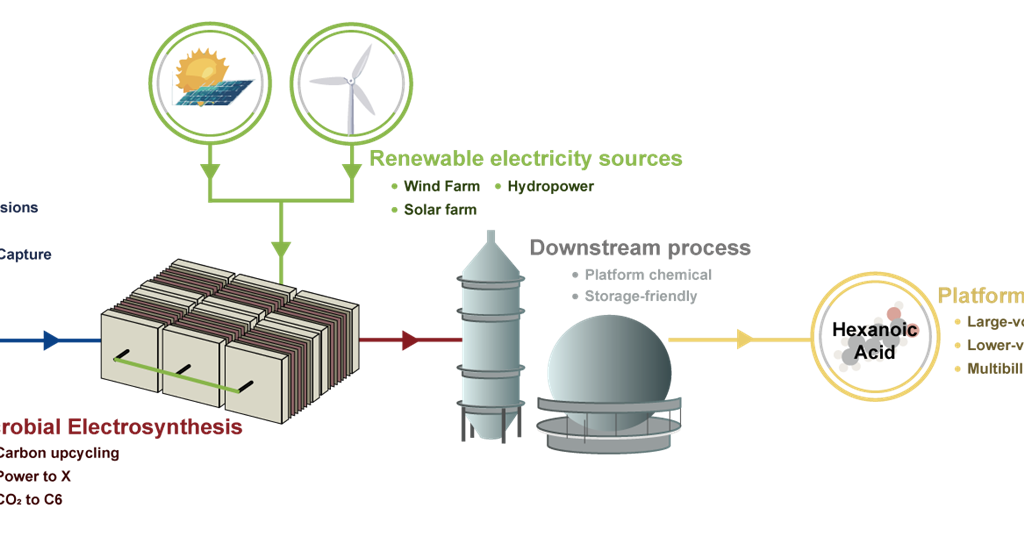
Whereas conventional electrosynthesis typically converts CO2 into small C1 and C2 molecules, MES is capable of producing more complex, longer chains. The technology achieves this with the aid of living micro-organisms, which attach themselves to one of the electrodes and take up electrons, after which they build chemicals from CO2. In doing so, MES produces, amongst other things, C2, C4, and C6 carboxylates, with C6 being the conjugate base of caproic acid. ‘The problem is that all these compounds are present in the same liquid,’ says lead author Mungyu Lee. ‘We therefore had to look for a selective method to extract C6 from the mixture.’
To this end, the researchers drew on earlier work from Straathof’s group, in which they presented an anion-exchange resin that proved suitable for the selective recovery of C6 and C7 from co-fermented organic waste. Lee optimised the use of this resin in adsorption/desorption, and demonstrated, after numerous experiments, how the use of CO2-expanded methanol — a sustainable variant produced from captured CO2 and hydrogen — for desorption was able to increase the selectivity of the process by a factor of 13.
According to simulations by the researchers, distillation of the desorbed mixture can yield a pure caproic acid concentration of 67 per cent in a single pass. After recycling the remaining carboxylates back to the MES reactor, they achieved a final concentration of more than 99 per cent. Jourdin: ‘Since MES uses a relatively simple medium, it allowed us to recycle unrecovered C2 and C4 carboxylates, with the bacteria converting them further to C6 and increasing its recovery.’
‘The biggest challenge here was integrating the two different technologies, MES and adsorption/desorption,’ says Lee. ‘For instance, certain chemicals are critically important for MES, yet act as a limiting factor in downstream processing. We tackled these issues through close communication between the different research groups, so as to bring all areas of expertise together.’
Throughout the entire process, MES accounts for the largest share of total energy demand — namely 90 per cent — to drive the microbial production. ‘As a next step, we are going to reduce this consumption,’ says Jourdin. ‘We intend to explore ways of making the reactor more energy-efficient.’
To scale their technology up to industrial volumes, the researchers are also collaborating with the Wageningen-based company Greencovery, which has provided financial support for their research. Jourdin: ‘Greencovery is working on scaling up adsorption/desorption, for example in the food industry to recover by-products. Through the collaboration, we are learning a great deal about this.’
A concrete step the researchers are already working on in the meantime is modelling adsorption at an industrial scale. Straathof: ‘We are coupling this to an economic model that should identify the optimal outcome when weighing up yield against selectivity. In this way, we are searching for the economic optimum.’
Mungyu Lee, et al., Sustainable production of pure hexanoic acid from CO2 using microbial electrosynthesis with in-situ product recovery, Chemical Engineering Journal (2025), doi:10.1016/j.cej.2025.169412


Every Wednesday in your inbox: the latest chemistry and life sciences news from the Netherlands and Flanders, plus analyses, background stories and more!


No comments yet
Only registered users can post comments on this article.
Log in or register to comment.