




Reaction Disclaimer

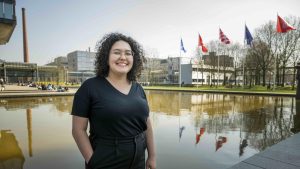
The sewage system is an epidemiological data source brimming with information about lifestyle and health. With the right technology, you can fish all manner of biomarkers out of wastewater, originating from medicines, pesticides, and viral particles, for example. ‘The concentrations of these substances are incredibly low — as though you were dissolving a sugar cube in a large pond,’ explains Tim Boogaerts, postdoctoral researcher at the Toxicological Centre of the University of Antwerp. ‘We therefore have to work with highly sensitive analytical methods.’ He is currently focusing on biomarkers of environmental contaminants such as pesticides and flame retardants. ‘Each type requires its own measurement method. We are in the process of developing these. We are also investigating which biomarkers should be given priority, as there are an enormous number of them.’
During his second year of study, Boogaerts had the opportunity to visit several laboratories and complete a summer placement. He chose the Toxicological Centre. ‘I was immediately captivated by wastewater as a subject of study.’ He has never looked back. ‘Even during holiday jobs, other placements, and my master’s project, I stayed in the sewers. I was lucky to find such a fascinating subject straight away.’
The coronavirus crisis began in the middle of Boogaerts’ doctoral research. ‘That was a remarkable experience. In a short space of time, wastewater analysis was transformed from a niche research field into an established tool for monitoring public health.’ But measuring viral particles requires different methods from the chemical techniques the scientist was accustomed to. ‘We then started a collaboration with the Laboratory for Microbiology, Parasitology and Hygiene at the university.’
‘We measure the sum total of every toilet visit in Belgium’
The coronavirus proved a true catalyst for the research field. ‘Suddenly, wastewater analysis came to the attention of policymakers and public health partners,’ says Boogaerts. Collaborations that began at the time because of COVID-19 are now expanding into areas that the Toxicological Centre has been examining for far longer. ‘For the past few months, we have been measuring drug biomarkers on a large scale across the whole of Belgium. This is giving us a much clearer picture of just how widespread drug use actually is.’
As his PhD drew to a close, Boogaerts knew: this subject is only going to grow. ‘I want to stay in the sewers for as long as possible and witness how this research domain continues to evolve in Belgium. I hope that our current research into environmental contaminants will ultimately also reach policymakers.’
In the meantime, Boogaerts takes great pleasure in communicating his subject to the general public. ‘We measure the sum total of every toilet visit in Belgium. That resonates with people naturally. We translate our work for different audiences, from a simulated sewage system for young children to interviews and presentations for adult audiences. That way, everyone can get a taste of our work — figuratively speaking, of course!’
What and where did you study?
‘Bachelor’s and master’s in Pharmaceutical Sciences at the University of Antwerp. Doctorate at the Toxicological Centre.’
What motivates you in your work?
‘The link between pure analytical chemistry and its relevance to public health.’
What are your ambitions?
‘I want to contribute to the further expansion of wastewater research in Belgium and Europe.’
What is your advice or tip?
‘During your bachelor’s, start looking around at research groups early on. I was lucky to find what I was looking for straight away, but discovering early what you don’t want is also extremely valuable.’


Every Wednesday in your inbox: the latest chemistry and life sciences news from the Netherlands and Flanders, plus analyses, background stories and more!


No comments yet
Only registered users can post comments on this article.
Log in or register to comment.