




Reaction Disclaimer

Scientists from the Luxembourg Institute of Science and Technology (LIST) and the University of Luxembourg have successfully transferred the widely used A549 cell line to an animal-free medium. In their article, published in mid-2022 in Toxicology in Vitro, the researchers describe the steps they followed and which media did and did not work effectively. The study was conducted in collaboration with PETA Science Consortium International, an organisation working on animal-free testing methods.
A cell line, consisting of a population of continuously dividing cells, serves as a model for a more complex bodily system and is suitable for conducting in vitro research. The A549 cell line comprises carcinogenic human alveolar (air sac)-like epithelial cells and was developed in 1972 using cells from a lung tumour of a 58-year-old man. The cell line is widely used in lung research and drug development. However, growing cells requires nourishment in the form of a medium.
‘This publication is one of the best-described examples of how to adapt a cell line to a serum-free medium’
A basal cell growth medium is usually supplemented with fetal bovine serum (FBS), or foetal calf serum. Many cell lines thrive on it, partly due to its low antibody content and abundance of growth factors. The serum is unique in its versatility, but it also has drawbacks. FBS is harvested from the blood of unborn calves, which are removed from the mother cow after she has been slaughtered at the abattoir. This occurs with approximately 1.8 million cows annually. The animal suffering involved in this process and in transport has long raised ethical questions.
Furthermore, FBS medium also has scientific drawbacks. Calf serum consists of an undefined mixture of molecules with significant batch-to-batch variation, which causes problems with the reproducibility of studies. FBS also influences cell phenotype and gene expression. Moreover, the inadequate regulation surrounding its sale encourages fraud, and the mixture may be contaminated with toxic substances and bacteria, amongst other things.
In 1958, geneticist Theodore Puck first published on FBS as a growth medium. ‘He mentioned drawbacks even then, but researchers have largely ignored them ever since,’ says Jan van der Valk, medical biologist at Utrecht University. Until the end of 2021, he headed the 3Rs centre, which works on methods to replace, reduce, and refine animal testing. ‘Cell lines are an alternative to animal models, but by using FBS you are still introducing animal products into your medium that may have been obtained through animal suffering. That creates a contradiction.’ Since the bovine spongiform encephalopathy crisis (mad cow disease) in 1989, scientists have been searching for animal-free alternatives.
A chemically defined medium allows most of these drawbacks to be circumvented. It contains no animal components and its exact composition is known. However, unlike FBS, it is not universally applicable — a new medium must be developed for each cell type. Xeno-free media may also be relevant. These are animal-free but may contain human components.
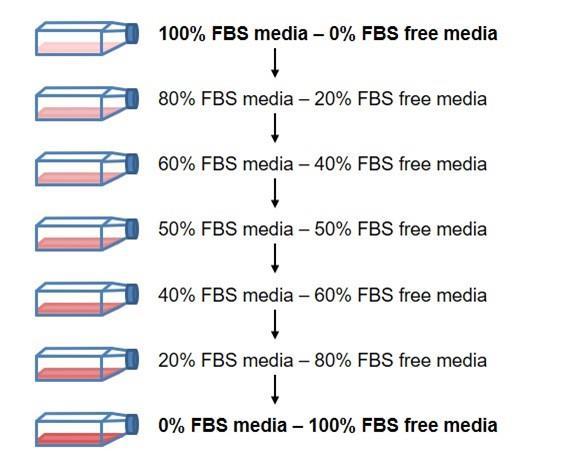
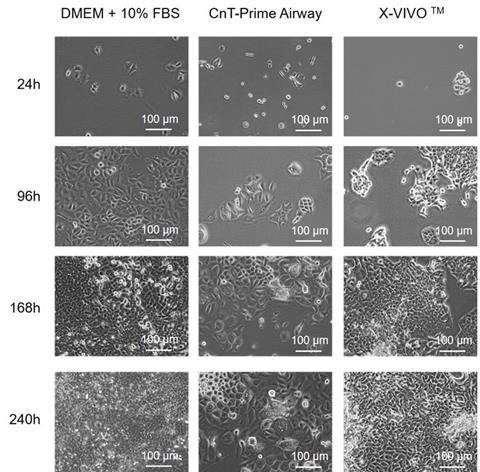
A cell line accustomed to FBS medium must gradually adapt to a new growth environment. The Luxembourg researchers achieved this using the commercially available media CnT-Prime Airway (CELLnTEC) and X-VIVO 10 (Lonza). X-VIVO 10 is a xeno-free proliferation medium developed for haematopoietic stem cells. Once transferred, the A549 cells displayed comparable properties and the same phenotype as in the ‘original’ FBS medium. The cells are cuboid in shape and relatively small. The research team recommends this medium when comparing results with existing data or when a homogeneous A549 population is required.
In CnT-Prime Airway, the cell line behaved differently. This medium is geared towards differentiation and was developed specifically for airway epithelial cells. The researchers observed remarkable morphological and physiological differences between the cell line in CnT-Prime Airway and in other media. The cells divided more slowly and differentiated towards cells of varying sizes, more closely resembling ‘normal’ lung epithelium.
‘This publication is one of the best-described examples of how to adapt a cell line to a serum-free medium,’ says Van der Valk. The team followed the step-by-step protocol that the medical biologist published with colleagues in 2010 in Toxicology in Vitro. ‘The researchers clearly demonstrate how to approach the adaptation. The cells need to be able to adjust, and the authors describe this so thoroughly that other scientists can reproduce it — for their own A549 cells, but also as a protocol for media yet to be developed for other cell lines.’
Van der Valk hopes to see research into animal-free media shift from individual laboratories towards large consortia. ‘We must stop reinventing the wheel. I would much rather see us develop a base medium that anyone can purchase or produce, and that can be tailored to one’s own cell line with just a few ingredients, such as specific growth factors.’


Every Wednesday in your inbox: the latest chemistry and life sciences news from the Netherlands and Flanders, plus analyses, background stories and more!


No comments yet
Only registered users can post comments on this article.
Log in or register to comment.