




Reaction Disclaimer

A biological cell is an ingeniously constructed thing. Consider its communication system alone, through which cells can ‘sense’ their environment using proteins and transmit signals to their neighbours, which can in turn respond to them. For an artificial cell, too, it is an important component that is still very much under development. Arjan Hazegh Nikroo, Jan van Hest and colleagues at TU Eindhoven have designed a coacervate system capable of releasing a protein in a controlled manner at a self-determined moment using ultraviolet light.
Van Hest’s group has been working on coacervate systems for some time — a polymer-rich phase in water in which droplets can form that serve as a platform for a synthetic cell. They had previously managed to programme the uptake of histidine-tagged proteins into stabilised coacervates. If a cleavable segment is then placed between the protein and the histidine tag, an enzyme can be used to cut it, causing the coacervate to release the protein into its surroundings.
It was already a step in the right direction, but in that system the enzyme begins cleaving immediately upon administration — and that is not how things work in a real cell. To gain greater control, the team therefore developed a protease that can be site-specifically blocked and subsequently activated with light at 365 nm.
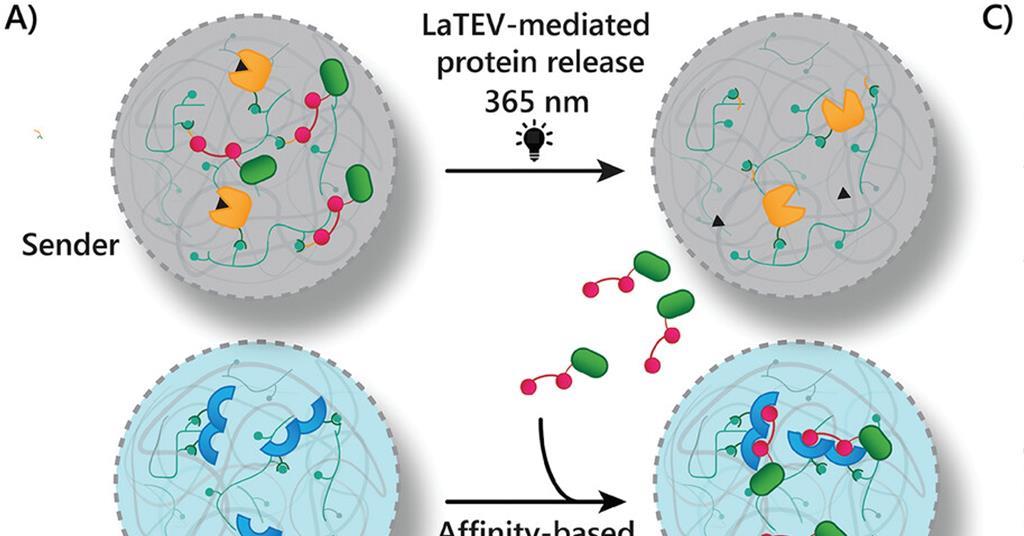
The mechanism works as follows: within a coacervate are the histidine-tagged proteins, the ‘caged’ proteases, and a number of other stabilising molecules. The moment light is shone on the whole, the ‘lock’ on the protease is released and it begins stripping the proteins of their His-tag. Those proteins can then pass through the membrane of the coacervate into the immediate surroundings.
The researchers went a step further still by placing a second coacervate population alongside the first (see below). The proteins are released from the first population, which acts as a ‘transmitter’. The second population takes up those released proteins and binds them to other proteins within those coacervates, which in turn act as receivers.
It is clear that this system benefits the artificial cell, but Van Hest and colleagues are hopeful that it could also pave the way towards communication between artificial and biological cells. There is still a long road ahead, but considerable work is certainly being done to get there.
Hazegh Nikroo, A. et al. (2024) Adv. Biol. 2400353, DOI: 10.1002/adbi.202400353


Every Wednesday in your inbox: the latest chemistry and life sciences news from the Netherlands and Flanders, plus analyses, background stories and more!


No comments yet
Only registered users can post comments on this article.
Log in or register to comment.