




Reaction Disclaimer

When you think of polymer research, worms probably don’t immediately wriggle into your mind. Yet it’s not such a peculiar idea, thought student Tess Heeremans and researchers Antoine Deblais, Daniel Bonn and Sander Woutersen from the University of Amsterdam. The common sludge worm (Tubifex tubifex) can, it turns out, serve perfectly well as a model for active polymers.
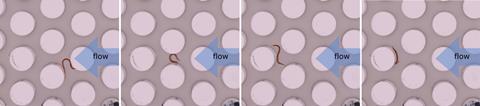
In a water flow containing various obstacles and openings (a sort of maze), they studied the hydrodynamic flow of the worms, comparable to what is known as slalom chromatography. The slender red worm is around 5 to 30 mm long, and its level of activity can be influenced in two ways: both low temperatures and a 3–5% ethanol solution cause the worms to move significantly more slowly. Release a cold or inebriated worm at the start of the water flow with obstacles, and it barely makes any headway, whereas a normal, warm worm covers a considerable distance and therefore has a shorter ‘elution time’.
Using these methods, they conducted tests which showed that active and small ‘polymer-like entities’ (the worms, that is) passed through the maze more quickly than less active (cold) and longer variants. That smaller worms move through the flow more readily is hardly surprising, but why active worms are faster was initially less clear. This turned out to be due to the conformations the worm adopted. Cold and inebriated worms remain elongated and in this way slide slowly between the obstacles, occasionally becoming stuck. Warm worms curl up more, adopting a more compact shape and thereby manoeuvring more easily through the openings.
Finally, the researchers investigated whether they could separate a mixture of inebriated and warm worms in a chromatographic manner. By placing both groups simultaneously at the start of the channel, a reasonable separation between the warm worms and the inebriated worms emerged naturally.
Slalom chromatography can be used to separate ‘conventional’ polymers by length, but those polymers (such as DNA) are not active — at least not as active as the worms. Group leader Sander Woutersen: ‘For active polymers, there is already theory and simulations, but no experiments, as they are far more difficult to produce than active particles (see this paper, eds.). The worms are a convenient model system that allows you to conduct experiments on active polymers nonetheless. Doing this experiment with microscopic active polymers could well prove extremely difficult; that sort of synthesis is not something we do, but it would of course be rather exciting if someone were to give it a go.’
Should anyone feel called to take up this challenge, the editors would be keen to hear about the results.
Heerema, T. et al. (2022) Sci. Adv. 8(23), doi.org/10.1126/sciadv.abj7918


Every Wednesday in your inbox: the latest chemistry and life sciences news from the Netherlands and Flanders, plus analyses, background stories and more!


No comments yet
Only registered users can post comments on this article.
Log in or register to comment.