




Reaction Disclaimer

Applied Science / Chemistry, Zuyd University of Applied Sciences
Research placement: Sustainable Polymer Synthesis group, AMIBM
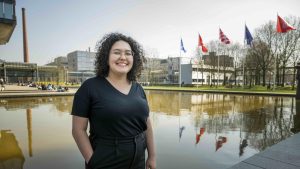
‘My placement focused on developing recyclable, bio-based alkyd resins for use in coatings. Conventional coatings release large quantities of VOCs, which is why work is being done to convert them to water-borne coatings via emulsions — but these often have a longer curing time. I therefore worked with a hybrid curing mechanism that can also offer recyclable properties. Recycling did ultimately prove possible, but it requires high temperatures, which in turn causes degradation. After investigating this mechanism, I produced emulsions, but stability turned out to be extremely difficult to achieve. At first I found it a challenging project, but it was great fun to work on. I got to grips with many new techniques by actually using them, and I learnt a great deal about data processing and analysis. When I heard at my assessment that I had received a 9, I was momentarily lost for words.’
‘I always used to think: “Working with coatings — that’s not for me.” But now I’ve discovered that it’s also really interesting to end up with a physical material you can actually work with. I wanted to focus on organic chemistry, but I struggled to find a placement, and it was through Evelien [Baeten, ed.], my supervisor at Zuyd, that I ended up at AMIBM, in Katrien Bernaerts’ group. I’m now doing a master’s in bio-based materials at Maastricht University, and I’ll be carrying out my research with Katrien’s group again. And after that, a job in R&D, I think. Then again, I always said I didn’t want to do a master’s, and that turned out differently too. So who knows.’
Life Science, HU University of Applied Sciences Utrecht
Research placement: Amsterdam UMC, Department of Pulmonary Medicine
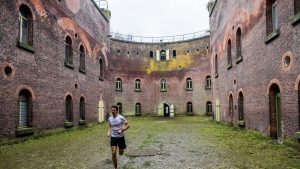
‘It was a very broad research project, focused on pulmonary arterial hypertension. This is a condition in which the right ventricle is affected and macrophages come into play. Patients often carry a specific mutation, BMPR2. I examined the differences between macrophages and cardiomyocytes [cardiac muscle cells, ed.] from patients and from a control group, and I also studied the interactions between the two. To do this, I had to differentiate both cell types from iPSCs [induced pluripotent stem cells, ed.], which was a great deal of work, as there was no adequate protocol for the macrophages — so I first had to optimise one.’
‘The start-up phase was difficult, as it was a new topic for the group. Nobody was working on this, which meant I had to figure everything out myself. That involved a lot of reading, a lot of protocol optimisation, and a great deal of practice differentiating the stem cells. On some days I filled as many as 300 aliquots. After about a month and a half it really started to come together, and that’s when it became genuinely enjoyable. At first I was nervous about working with the equipment and worried the cells would die, but my confidence grew as I went along.’
‘When I had eventually run everything through the flow cytometer and presented the results, everyone was impressed. We really did find something new about the macrophages, and the research has been taken further by a PhD student. There will also be a paper with my name on it — I’m enormously proud of that. I’m now doing the pre-master’s in Biomedical Sciences at Radboud University, and after that I want to do a PhD. I want to do so much more research.’
Applied Science, Fontys Eindhoven
Research placement: Molecular Biosensing group, TU Eindhoven
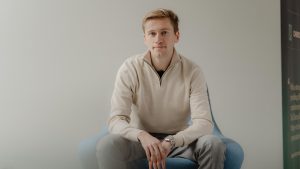
‘This group works on biosensors for use in continuous monitoring — for example, to measure the concentration of certain substances in wastewater. The subject of my project was to investigate whether the much smaller nanobodies could be used in these sensors instead of antibodies. I started with the most straightforward test, via direct immobilisation, and from there we proceeded step by step. I used molecules of varying sizes as a model to see what works: the protein lactoferrin as a very large molecule, diclofenac as a small molecule, and IL-6 as something in between.’
‘I demonstrated that the use of nanobodies is conceptually viable and that it is worthwhile investigating this further. With lactoferrin, we got quite far — not only in a well plate, but also in a flow setup of the kind you would ultimately want to use. The research went smoothly; I had previously worked on a project for this group, so I was already familiar with the technique, which saved a great deal of time at the outset.’
‘Since the end of 2024, I have been employed as an analyst at my first placement company, NutriControl in Veghel. There’s scope for me to progress to R&D analyst here. My advice to those finishing their degrees: try not to feel overwhelmed by what comes your way. Work out a plan calmly, together with your supervisor. You have plenty of time for your research. Enjoy it too — I found all my projects and placements genuinely rewarding. And try to set goals beyond your project as well: what do you personally want to get out of it?’


Every Wednesday in your inbox: the latest chemistry and life sciences news from the Netherlands and Flanders, plus analyses, background stories and more!


No comments yet
Only registered users can post comments on this article.
Log in or register to comment.