


Reaction Disclaimer

Ubiquitous polyurethane foam, found in countless products, almost always ends up in landfill or the incinerator after use, owing to the lack of an efficient recycling process. Current processes, for instance, require the use of toxic phosgene to reuse the building blocks. As a result, large-scale recycling of polyurethane foam remains out of reach for the time being.
That may be about to change, as researchers at the University of Twente have developed a new, environmentally friendly method to break down the foam into its original building blocks — without the use of hazardous chemicals. ‘Using our chemical method, we depolymerise polyurethane foam into its monomers, which can then be reused via a green process,’ says supramolecular chemist Jurriaan Huskens, professor at the University of Twente and lead researcher on this project.
Polyurethane foam — or PU foam — can already be depolymerised into one of its monomers, polyol, using existing methods. But to reuse the other monomer, the diamine, for the formation of polyurethane, phosgene is required. Honorary professor and chemist Jean-Paul Lange, also of the University of Twente, set out to find a better approach and joined forces with Huskens to do so.
‘Under the right conditions, as much as ninety per cent of both components can be recovered’
Jurriaan Huskens
Together with PhD candidate Ege Hosgor, first author of the study, they now demonstrate in Green Chemistry that using diethyl carbonate, polyurethane foam can be broken down harmlessly into both precursors, which can subsequently be repolymerised without phosgene. Huskens: ‘Under the right conditions, as much as ninety per cent of both components can be recovered.’
The current method offers several green advantages and enables a circular synthesis of polyurethane foam. ‘For instance, it avoids the formation of toxic amines as an intermediate product and the release of chloride waste from the use of phosgene,’ says Lange. ‘On top of that, the carbonate reagent can be made entirely renewable from ethanol and carbon dioxide.’
The researchers tested their reactions on various types of polyurethane foam, from mattresses and furniture to sports shoe soles and sponges. ‘We added small quantities of this PU foam directly to the diethyl carbonate,’ says Huskens. ‘That quickly proved to work well, provided we used a sufficiently high temperature and a catalyst — zinc acetate — to speed up the reaction. After letting everything react together for a few hours, we were left with an almost entirely liquid substance. It worked equally well for all the different types of polyurethane foam.’
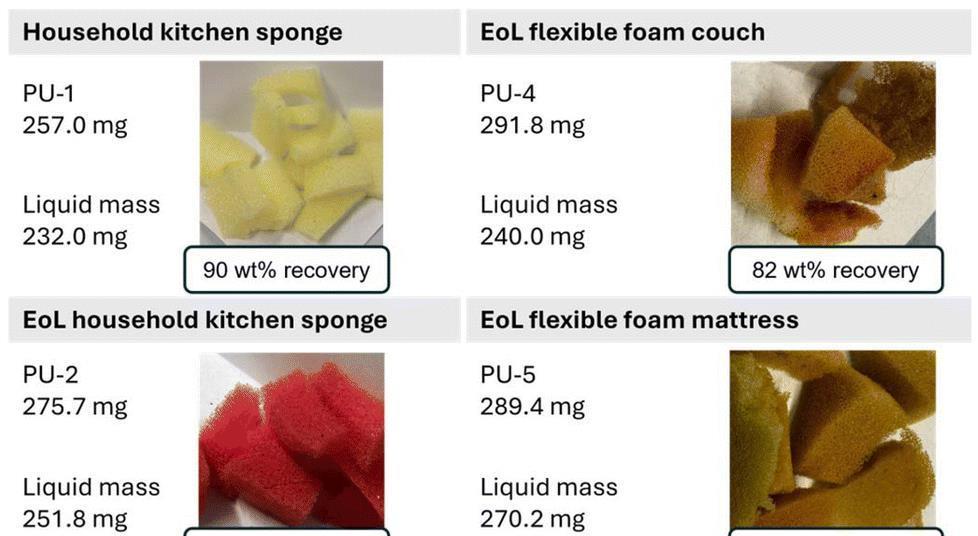
Though that was only where the real work began for the researchers. Huskens: ‘Analysing the product distribution of this fairly complex mixture of substances was the greatest challenge. Initially, the mixture still contains several oligomers, and the amines not occupied by a carbonate occur in various isomeric forms. We used NMR to study the distribution of monomers and oligomers, how many functional groups surrounded the monomers, and so on. Although the chemistry itself was actually running quite well fairly quickly, the analysis still required a great deal of outside expertise.’
‘We still have a great deal to refine’
Jean-Paul Lange
As is often the case with breakthroughs in academia, considerable work remains to be done before the process can be scaled up to industry. ‘Our current process is fairly complex and does not yet yield the desired monomers directly, but only the precursors that must then be converted back into the monomers,’ says Lange. ‘In addition, diethyl carbonate is more expensive than phosgene, which leads me to estimate that, despite the reduced toxicity, the process will be more costly than current methods.’
As a next step, the researchers therefore wish to delve deeper into both the chemistry and the technical aspects of the process. Lange: ‘On the chemistry side, we want to increase the reaction yield, identify which unwanted by-products are formed, and study how these affect the reaction. On the technical side, we need to analyse the costs, determine the kinetics and thermodynamics of all the steps, and identify the most suitable equipment. We still have a great deal to refine.’
Ege Hosgor, et al., Polyurethane depolymerization by dialkyl carbonates: toward sustainable chemical recycling, Green Chemistry (2025), doi:10.1039/d5gc02533h


Every Wednesday in your inbox: the latest chemistry and life sciences news from the Netherlands and Flanders, plus analyses, background stories and more!


No comments yet
Only registered users can post comments on this article.
Log in or register to comment.