



Reaction Disclaimer

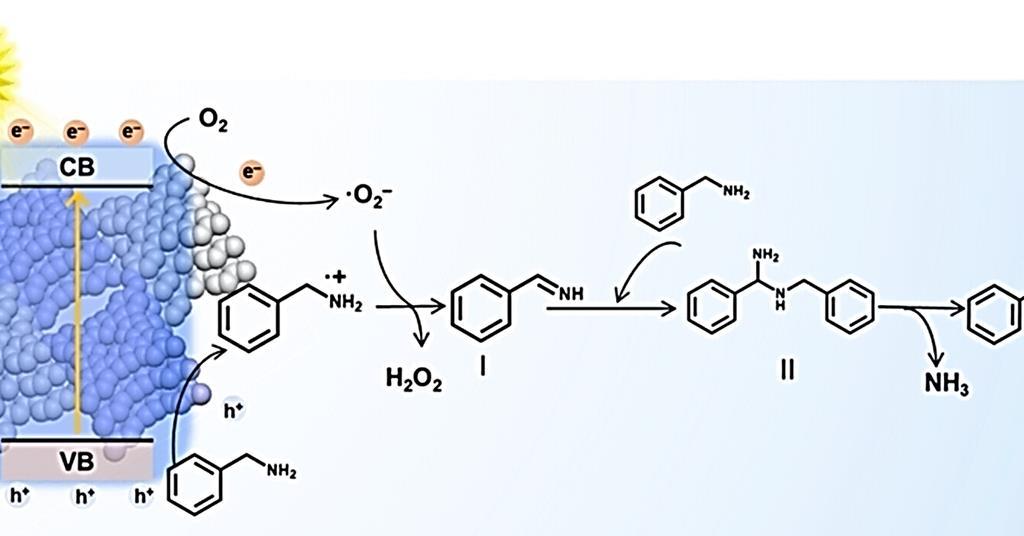
Producing useful molecules more sustainably is high on the priority list of many chemists. That is why Linyang Wang, Pascal Van Der Voort and colleagues from Ghent University set out to find photocatalysts that use light to couple amines into imines — structures frequently encountered in the pharmaceutical industry owing to their reactivity and antibacterial effects. They chose pyrene as a foundation and created three different versions of so-called COFs.
Metal-organic frameworks (MOFs) will be familiar to most readers of C2W | Mens & Molecule, but less well known are the COFs that the Ghent team designed. As we wrote previously, such a COF consists of organic molecules linked together via covalent bonds into a kind of chicken wire. That mesh can then be stacked into a porous 3D structure. It bears a strong resemblance to MOFs, but without any metal.
In this case, the best of the three COF variants was one combining pyrene and porphyrin [5,10,15,20-tetrakis(4-aminophenyl)porphyrin]. Pyrene is by nature a good electron donor, whilst porphyrin is a good electron acceptor. Together they form an effective donor–acceptor combination that can distribute electrons in light efficiently.
The resulting Py-Por-COF then converts benzylamine into N-benzylidenebenzylamine with remarkable efficiency under almost laughably simple reaction conditions: at room temperature, in open air, with an hour’s exposure to blue light, yielding 99% with a photocatalytic activity of 20 mmol per gram per hour — one of the highest values ever reported.
The researchers converted other amines in the same way, achieving yields of ninety per cent or more. They also examined the recyclability of Py-Por-COF. After four rounds of reactions, the activity and efficiency of the COF remained above ninety per cent, making it perfectly suitable for reuse.
Wang, L. et al. (2024) ChemCatChem e202400200, DOI: 10.1002/cctc.202400200


Every Wednesday in your inbox: the latest chemistry and life sciences news from the Netherlands and Flanders, plus analyses, background stories and more!


No comments yet
Only registered users can post comments on this article.
Log in or register to comment.