

Reaction Disclaimer

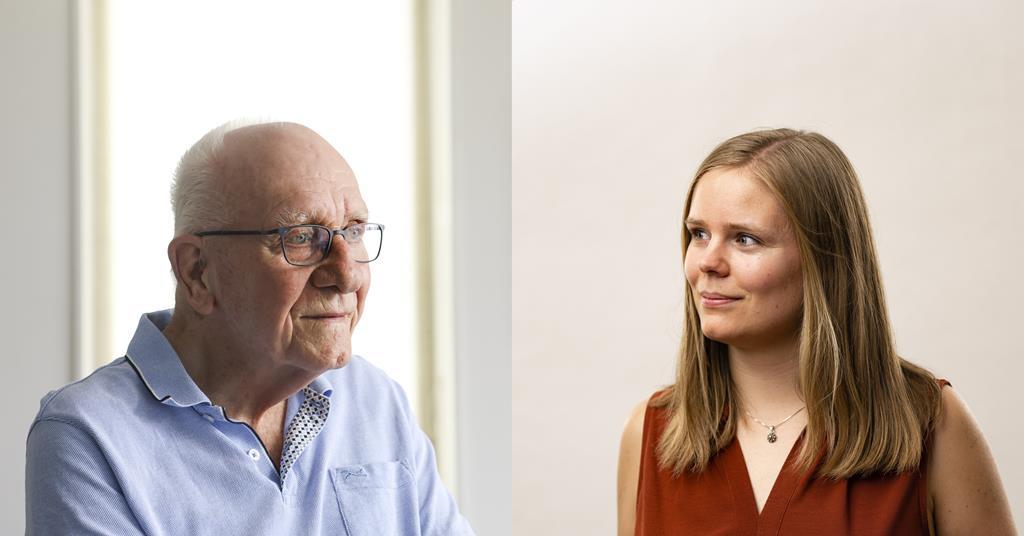
‘In the old days, people often modelled on intuitive grounds, which I found deeply unsatisfying,’ recalls Wim Nieuwpoort. ‘I was a bit stubborn about it and didn’t really consider it proper science.’ According to Nieuwpoort, modelling means approximating the solutions of fundamental equations — such as the Schrödinger or Navier-Stokes equations — as accurately as possible. ‘I was working on this in the early sixties, but I quickly ran up against the limitations of the computers available at the time.’
‘I would never have imagined back then that all of this would grow out of my work.’
He had to work hard to complete his doctoral research, begun in the United States, alongside his regular work at the Philips Natlab in the Netherlands. During that period, Nieuwpoort became convinced that computing with computers offered tremendous new possibilities. ‘Working with complex equations and simulations of their solutions — that was the future.’
It was for this reason that Nieuwpoort began working to improve computing capabilities in the Netherlands. He recalls: ‘The facilities were rather inadequate at the time, and expensive too. I had seen in America what was possible and what it required. Back in the Netherlands, I campaigned with some success to secure the most powerful computers we could get. First within Groningen itself, but something also had to be done at the national level.’
‘Around 1966–1967, I began bringing together a number of professors and researchers from industrial laboratories — such as Shell, DSM and Unilever — from my base at the Philips Natlab, to discuss quantum chemistry and the use of computers in that field. Encouraged by this, I submitted a proposal together with Professor George Schuit (Shell/TU/e) to the then ZWO foundation (the predecessor of NWO, ed.) SON, to establish a Working Community for Quantum Theoretical Chemistry. That proposal was approved, and the working community functioned for many years as a central point for the distribution of research grants and the organisation of scientific meetings. I served as its chairman twice, and it was from that position that I began my initiatives to establish a national supercomputing centre (the Academic Computing Centre Amsterdam Foundation, SARA, ed.).’
‘As molecules grow larger, everything becomes a great deal more complicated.’
All of this was driven by the idea of the so-called ‘third way’, Nieuwpoort explains. ‘Alongside experimental and classical theoretical research, we had numerical research. I already felt at the time that I needed to pursue proper facilities for numerical research, and I still consider that extremely important. I devoted years to this alongside my own research in Groningen, with the indispensable support of Patrick Aerts, who later became director of the NWO foundation NCF. I would never have imagined back then that all of this would grow out of my work on chemical bonding in a few metal carbonyls — which was also the subject of my doctoral thesis. That work later turned out to have been the first ab initio calculation on transition metal compounds.’
The concept of ‘theoretical chemistry’ has, incidentally, changed somewhat over the years, Nieuwpoort believes. ‘At the beginning of the last century, it was primarily about applying thermodynamics and physical methods. Later, it became more concerned with quantum mechanics.’ He notes that people sometimes forget there was a time when no one had any idea why atoms bond together to form molecules. ‘Researchers such as Pauling and Eyring realised that quantum mechanics was indispensable for gaining an understanding of the electronic structure of molecules, and with it of the chemical bond.’
When computers appeared to assist in this work, the question also arose as to whether it should still be called theoretical chemistry. In summary, Nieuwpoort observes that the umbrella term today denotes a combination of computational and theoretical chemistry. ‘Ultimately, it all comes down to straightforward physical knowledge. But as molecules grow larger, more and more bonds come into play and everything becomes a great deal more complicated.’
CV Wim Nieuwpoort
1953–1959 Study of Chemistry with Physics, University of Amsterdam
1960–1963 Research associate, Purdue University, University of Chicago, Argonne National Laboratories (United States)
1960–1968 Staff member, Philips Physics Laboratory
1965 PhD, University of Amsterdam
1968–1996 Professor of Theoretical Chemistry, University of Groningen
1997 Interim Director, SARA
1997–2007 Chairman of the Board, Institute for Mathematics and Computer Science, University of Groningen
A joint interview with Wim Nieuwpoort and PhD student Marjolein de Jager about their time as students and their field of theoretical chemistry can be read here.


Every Wednesday in your inbox: the latest chemistry and life sciences news from the Netherlands and Flanders, plus analyses, background stories and more!


No comments yet
Only registered users can post comments on this article.
Log in or register to comment.