


Reaction Disclaimer

It is the reason for a large proportion of people who request a coronavirus test at the public health service: to rule out coronavirus as a precaution when experiencing vague symptoms or after contact with an infected person. It is therefore frustrating that, by the time you receive your result, you have already lost one to two days. This reduces labour productivity and raises the threshold for actually making the trip to the testing centre.
One person had to be admitted to hospital shortly after receiving a negative breath test result – for coronavirus
Hence the enthusiasm with which the then Dutch Minister of Health Hugo de Jonge greeted the first results of a genuine coronavirus breath test, developed by the Leiden-based company Breathomix (a spin-off of the AMC in Amsterdam), which can rule out coronavirus infection in 70% of people within a matter of seconds – the remainder still receive a PCR or rapid test. On the basis of the validation study, De Jonge asked the Healthcare and Youth Inspectorate (IGJ) for a temporary exemption from the normally required CE certification, in order to deploy the test as quickly as possible.
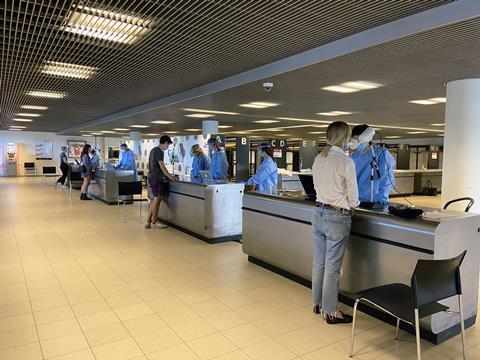
By early February, the moment had arrived: after a few months of pilot testing in Amsterdam-Noord and the RAI, the breath test was deployed at four testing centres in Amsterdam. Over the following months, the test was set to be rolled out across the remaining Dutch testing locations. But a spanner was soon thrown in the works: some thirty people turned out to have coronavirus after all, having been sent home reassured on the basis of the breath test result. One of them, VU professor of sports law Marjan Olfers, even tweeted that she had to be admitted to hospital shortly after receiving a negative breath test result.
According to Breathomix, the public health service had made errors and the majority of cases did not in fact involve a genuinely incorrect result. Some of these individuals had probably simply not yet tested positive at the moment of blowing, and had done so a few days later. But the company was no longer able to verify this, and it certainly did not apply to all thirty cases. Better staff training and a swift restart was the plan in mid-February, but two months on, this has yet to happen. Were expectations set too high?
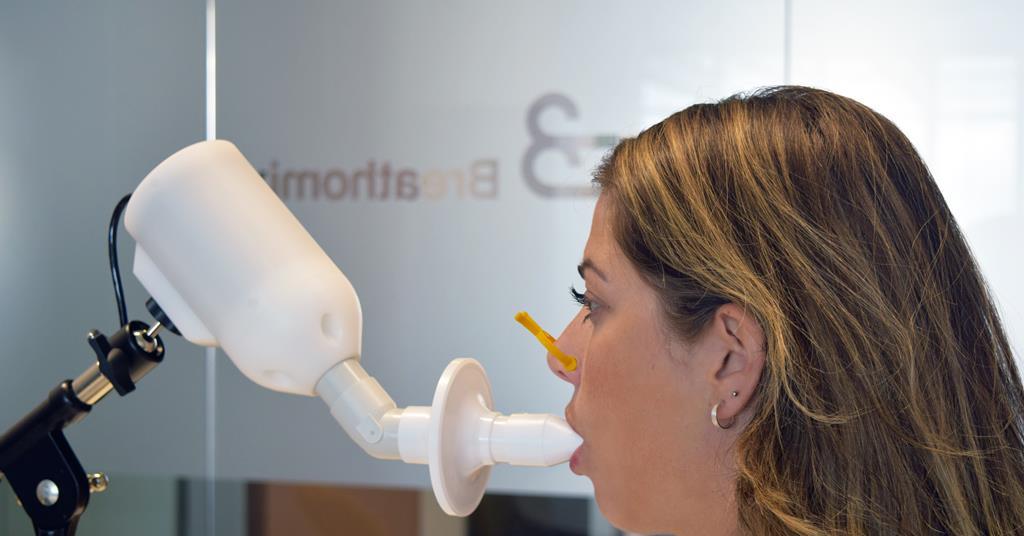
The SpiroNose, the electronic nose developed by Breathomix, determines whether a person is infected with SARS-CoV-2 based on breathing patterns. Seven sensors form the backbone of the SpiroNose. They measure both the air blown into a small buffer unit connected to the device and the ambient air. The device sends the measured pattern directly to Breathbase, a cloud database containing the results of tens of thousands of individuals with and without coronavirus infection.
‘The reliability of the device is fairly dependent on local conditions’
The device does not detect the virus itself, but rather so-called volatile organic compounds (VOCs), which are released in response to the infection during inflammatory processes, among other things. Which compounds these are and what their origin is are not particularly relevant: this is purely a matter of correlations. It represents a different approach from earlier breath test initiatives, which have for years held great promise for a range of diseases, and where it has proved extraordinarily difficult to unravel the underlying mechanism.
Hence the decision with the coronavirus breath test not to detect the infection, but to rule it out in a proportion of people. This requires high selectivity (virtually no coronavirus infection is missed) against a relatively low specificity (a large proportion of people who do not test negative go on to do so with a PCR test).
During the validation test, published online as a preprint in mid-February, the SpiroNose performed excellently. The researchers from Breathomix, Leiden University and Franciscus Gasthuis conducted the validation by first collecting breath profiles and PCR tests from 904 participants, of whom 35 tested positive by PCR. They then validated this algorithm on a further 904 participants, of whom 33 tested positive.
The researchers subsequently replicated the results at a different testing centre in December, when the virus was more widespread, with 1,948 participants, of whom 230 tested positive by PCR. Finally, they also tested the breath test on 754 asymptomatic individuals who had been in contact with an infected person, of whom 50 tested positive by PCR.
(Text continues below the image)
During the validation study, the SpiroNose identified all PCR-positive individuals; during the replication study and among asymptomatic individuals, the device missed one positive case each. Both had a relatively low viral load, making the likelihood of them being infectious small. Specificity stood at around 80%: one in five participants referred for a PCR test subsequently tested negative.
Suitable as a screening tool, then, concluded the Outbreak Management Team, which assessed the study. What remains unclear is whether the SpiroNose is able to distinguish COVID-19 from other respiratory infections, or whether it merely identifies those without respiratory infections, after which a PCR test must provide a definitive answer. But even that would represent a significant gain: after all, a large proportion of those being tested can be quickly and inexpensively reassured.
Shortly after the introduction of the coronavirus breath test at the Amsterdam public health service, Breathomix director Rianne de Vries was still brimming with confidence when speaking to RTL News: she could already envisage the breath test not only being rapidly deployed at almost all public health service testing centres, but also being used by businesses and even within the hospitality industry. Following the setbacks, she is considerably more measured on that front: ‘That won’t happen overnight. The reliability of the device is fairly dependent on local conditions. But I can imagine setting up such a device in a standardised location in a marketplace.’
‘A test that can rule out coronavirus 100% of the time sounds too good to be true – and it is’
Patrick Bossuyt is Professor of Clinical Epidemiology at Amsterdam UMC and specialises in evaluation research. ‘A test that can rule out coronavirus 100% of the time sounds too good to be true – and it is,’ he says in response to the issues surrounding the test. ‘Even if you design the test to minimise the risk, cases will still slip through.’
For screening tests used for other purposes in hospitals, for example, the accepted failure rate is 1.5%. And here you also have to contend with change over time: people can indeed test negative at one moment and positive the next day. The decision to halt the test may therefore have been partly due to the test not performing as well as expected, but at least equally because we had unrealistic expectations of it.
The 1,850 ordered units of the SpiroNose for Dutch testing centres are now awaiting the green light for reintroduction.
The publication on the SpiroNose validation study: De Vries, R. et al. (2021) MedRxiv, 16 February
Other initiatives
The Dutch coronavirus breath test may be the only one to have been (briefly) introduced, but it is not the only one in the world. Several others are still being tested, including in Finland, Israel, Dubai, Indonesia and Great Britain. Belgian researchers have developed a slightly different variant: their breath test does not rely solely on sensors that register organic compounds, but also analyses them using gas chromatography-mass spectrometry (GC-MS). Several other companies claim that their test can detect the virus itself in exhaled breath. None of these devices has yet been approved for use.


Every Wednesday in your inbox: the latest chemistry and life sciences news from the Netherlands and Flanders, plus analyses, background stories and more!


No comments yet
Only registered users can post comments on this article.
Log in or register to comment.