



Reaction Disclaimer

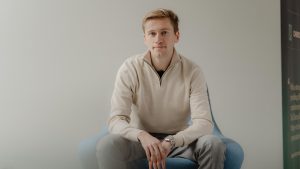
Axel Degrande (26) completed his vocational secondary education [bso – beroepssecundair onderwijs, broadly equivalent to vocational qualifications at secondary level, ed.], went on to study electromechanics at university of applied sciences, then completed a Master’s in Industrial Sciences, and is now a PhD student. ‘I’m building a medical robot that repositions the lower body inside a CT scanner,’ Degrande explains. ‘Alongside the theoretical side, I work a lot with my hands – just like I did during my vocational training. As a researcher, I’m right at the cutting edge of the latest technology, which is incredibly exciting.’
By his own admission, Degrande used to be ‘the worst’ in his class. ‘I was a troublemaker and never did my homework. It didn’t interest me. I wasn’t being challenged.’ At university of applied sciences, he suddenly had to start cramming. ‘I actually found that quite exciting. My biggest fear was mathematics – and that fear turned out to be entirely justified.’ He laughs. ‘During the very first lesson, the lecturer wrote an equation on the board. “Find X,” he said. Confused, I turned to my classmate and asked: “But X is right there on the board, isn’t it? Is it some kind of multiplication sign?” I had never seen an equation before!’
Degrande caught up on his backlog through extra lessons and educational YouTube videos. ‘It turned out I was actually good at mathematics.’ He began to wonder whether he could manage university. ‘I wanted to be certain first that it wasn’t just about the qualifications for me. So I stepped out of my comfort zone by choosing the most theoretical graduation project I could find.’ He enjoyed it, and decided to go for it. ‘I’d been warned about the bridging programme between the university of applied sciences and the Master’s – that it would be extremely demanding.’ That proved to be true. ‘It was the hardest period of my life. I was enormously stressed and overworked.’ But Degrande’s combative nature reasserted itself and he completed the programme.
‘I stepped out of my comfort zone by choosing the most theoretical graduation project I could find’
Once at university, he could breathe again. ‘I started seeing my friends again and could go out to the pub.’ Nevertheless, Degrande still feels the after-effects of his bridging year. He can no longer write properly. ‘Back then, I studied by writing everything down. That was how I retained the material. Now, the moment I pick up a pen, my hand shakes terribly.’ There is a whiteboard in Degrande’s workspace. ‘With a thick marker, writing still works well enough.’
The researcher tells his story from Thailand, where he is backpacking with his girlfriend. She comes over to join him briefly. ‘We’ve been together for seven years, so I’ve been there for every step of it. Axel has always kept following his passion.’ Degrande sometimes forgets just how unique his academic journey really is. ‘When I received my Master’s degree, the dean told my entire story to a lecture hall of a thousand people. Suddenly I realised everything I had actually achieved. I was nearly in tears.’
What did you study, and where?
‘Electrical Installations and Maintenance, GTI Beveren; Electromechanics, AP University of Applied Sciences Antwerp; Master’s in Industrial Sciences, University of Antwerp – and I am now a PhD Researcher at the Cosys-Lab, University of Antwerp.’
What motivates you in your work?
‘My colleagues. They alone make going to work feel like a celebration.’
What are your ambitions?
‘All being well, I’ll be publishing my first paper soon. In the future, my girlfriend and I both want jobs that allow us to work as digital nomads – so we can always be travelling.’
What is your advice or top tip?
‘Listen to your body and look after your mental wellbeing. Self-reflection helps!’


Every Wednesday in your inbox: the latest chemistry and life sciences news from the Netherlands and Flanders, plus analyses, background stories and more!


No comments yet
Only registered users can post comments on this article.
Log in or register to comment.