





Reaction Disclaimer

There is no denying it: CRISPR/Cas has turned the world of gene editing on its head. ‘When CRISPR/Cas appeared on the scene, everything was simply a great deal easier,’ says Thomas Jacobs, group leader of the gene-editing group at VIB-UGent Center for Plant Systems Biology. Not that all plants are equally straightforward to modify, but it was a vast improvement on what had previously been possible. Yet even for the CRISPR/Cas system, there remains plenty of room for improvement.
A CRISPR experiment begins with determining which gene or genes you wish to modify. You then design a guide RNA that directs the Cas enzyme to the site of the intended modification. There, the Cas enzyme makes a cut in the DNA, after which the cell’s DNA repair system mends the break — ideally, in this case, with a small error introduced in the process. By using a modified Cas enzyme that does not cut but instead carries an additional module — one that, for example, changes a C (cytosine) into a T (thymine) — individual bases can be substituted.
‘We want the DNA to enter, perform its function, and then disappear again’
Wout Boerjan, VIB-UGent Center for Plant Systems Biology
A gene-editing experiment stands or falls by its design. That is precisely why Lycka Kamoen wants to understand how the plant repairs its DNA. ‘Most of the time it does so flawlessly,’ says Kamoen, ‘but the beauty of CRISPR/Cas is that it simply tries again. As many times as it takes until a mutation occurs.’
Repair method
Kamoen, who is conducting research into CRISPR/Cas and DNA repair as a postdoc at Leiden University, explains that when it comes to repairing double-strand DNA breaks in plants, two forms dominate: non-homologous end-joining and polymerase theta-mediated end-joining. The former, when it makes an error, either inserts an extra base or removes between one and four. The latter is by definition imperfect and removes around 20 bases.
‘The reason for this is that polymerase theta end-joining makes use of small repeats on either side of the break,’ says Kamoen. ‘This is also known as microhomology. And in plants, you need on average approximately three bases, which is really very few.’ Because the repeats are so short, they occur throughout the genome.
‘Just designing experiments on that scale took months’
Thomas Jacobs, VIB-UGent Center for Plant Systems Biology
The choice of Cas enzyme appears to have little bearing on the outcome of break repair. However, with the guide RNA design, researchers can steer which repair mechanism the plant employs. It works as follows: under normal circumstances, non-homologous end-joining repairs approximately 70% of breaks. But when the break is flanked by longer microhomology sequences, polymerase theta-mediated end-joining takes over more frequently. Kamoen: ‘Because of that longer microhomology, we can also better predict what the resulting mutation will look like, whereas ordinarily this is fairly random.’
Architecture
The choice of Cas enzyme is, however, linked to the guide RNA design. ‘If there happens to be no PAM sequence adjacent to the location of your guide RNA, it simply will not work,’ says Professor Wout Boerjan, who works on gene editing in poplars at VIB-UGent Center for Plant Systems Biology. The PAM sequence, which is a few bases long, differs for every Cas enzyme. ‘The more Cas variants we discover, the easier it becomes and the better placed we are to select which Cas to use for which purpose,’ Boerjan explains.
It is not only the guide RNA and the specific Cas enzyme that are important to the success of gene editing — the architecture of the CRISPR/Cas construct also plays a role. And in particular the promoters and nuclear localisation signals. ‘The architecture we went with was the same as that used in human cells,’ says Jacobs. It proved effective not only in the model plant Arabidopsis, but also in wheat and maize.
‘The beauty of CRISPR/Cas is that it simply tries again’
Lycka Kamoen, Leiden University
Yet there turned out to be room for improvement. ‘We stumbled upon it more or less by chance,’ says Jacobs. He had been testing reporter proteins with various nuclear localisation signals, which direct proteins to the cell nucleus. ‘We went from “Hey, this one actually works a great deal better. I wonder what it will do with Cas9.” A small test led to a more extensive one and to a design that is considerably more efficient.
Moreover, time savings were also found to be possible in the design phase of a CRISPR/Cas experiment. Because multiple genes often influence a single trait, researchers and plant breeders increasingly want to make multiple modifications simultaneously. Jacobs: ‘We noticed that just designing experiments on that scale could take months.’ Thanks to software tools developed by his group, this can now be done in a matter of minutes.
T-DNA
Once the experiment has been designed, it is time for the actual gene editing. Using the bacterium Agrobacterium tumefaciens, researchers introduce the CRISPR/Cas construct into the plant. For many of the plants used in the laboratory, this works well enough. ‘But certain commercial varieties are not at all easy to transform,’ says Boerjan. Researchers are therefore looking for alternatives, such as other A. tumefaciens strains or viruses for delivering the guide RNA and Cas enzyme into the plant cell.
The use of A. tumefaciens presents a further problem: it integrates part of its DNA — the so-called T-DNA — into the plant’s genome. Something that proves highly useful for conventional genetic modification of plants. ‘But for gene editing, we want the DNA to enter, perform its function temporarily, and then disappear again,’ Boerjan explains.
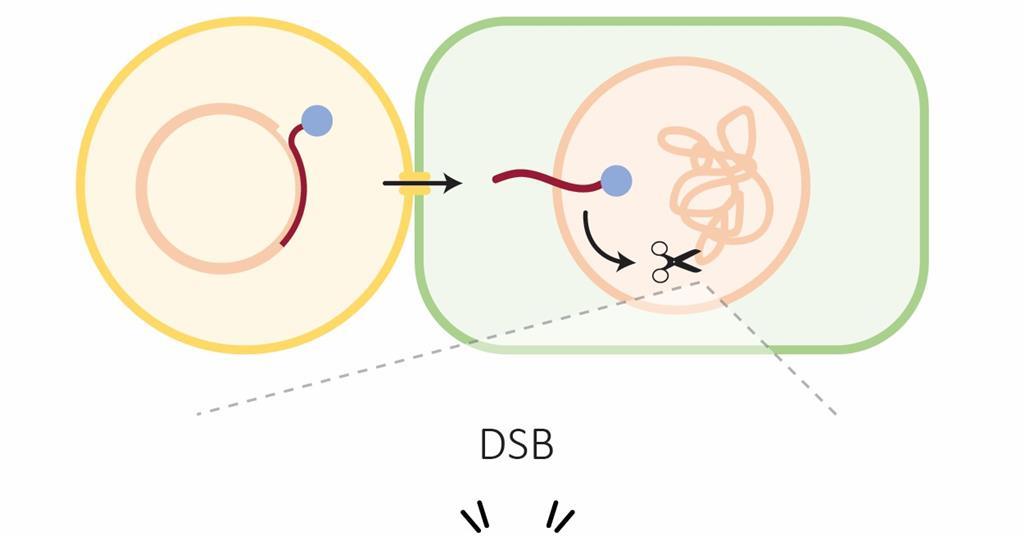
To achieve this, his group included an additional instruction with the introduced DNA, in the form of a base edit that renders the cell resistant to herbicides. This enabled the researchers to select cells that had been edited. Boerjan: ‘You then have a series of shoots that are either free of T-DNA or still carry a T-DNA.’ The researchers could then proceed with the T-DNA-free plants.
Kamoen is now also focusing on T-DNA integration into the genome. In her earlier research, she obtained hints that polymerase theta-mediated end-joining influences the integration of T-DNA into the plant genome. She is currently investigating precisely how this process works.
Meanwhile, Wageningen University & Research is searching for new Cas variants. And the teams in Ghent are pursuing research into CRISPR combo — where researchers couple an activator to the Cas enzyme to selectively activate another gene rather than modify it. This could also be an option for selectively activating genes that initiate the regeneration of plant cells.


Every Wednesday in your inbox: the latest chemistry and life sciences news from the Netherlands and Flanders, plus analyses, background stories and more!


No comments yet
Only registered users can post comments on this article.
Log in or register to comment.