




Reaction Disclaimer

Inorganic Chemistry & Catalysis, Utrecht University
Ina Vollmer / Adrian Hergesell
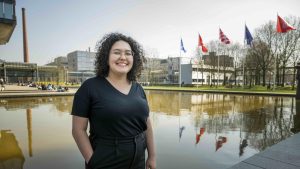
‘In the group, we work on new methods for recycling plastic using mechanical forces. Think of using a ball mill where shaking ceramic balls convert polypropylene back into propene. I looked specifically at the use of coatings to make the balls catalytically active for higher plastic conversion. It was an interesting process that was ultimately concluded nicely, but at the outset we had a completely different idea about how to obtain catalytic activity. I was getting rather “strange” results, and so we started looking at it from a different theoretical angle. We found that the catalytic reactivity lies in the presence of unpaired electron species on the coating. We proposed a hypothesis for this, and further research is now needed. It is still a very new field and much more needs to be investigated about exactly what happens at the nano level within that coating. I do feel that I have contributed something to this new form of reactivity, and it also led to a JACS paper. In the meantime, I have started a PhD trajectory, also in Utrecht within the group of Peter Ngene. I have found that I derive great satisfaction from doing research.’
Chemical Engineering, TU Delft
Optoelectronic Materials / Tom Savenije
‘I looked at the role of additives in improving the properties of narrow band tin-lead perovskites. Tin oxidises rapidly, which has an adverse effect on the performance of these perovskites in, for example, solar panels. In my project, I investigated whether additives counteract this oxidation and also how they influence the electronic, optical, and structural properties of the perovskite materials. My results have been incorporated into a paper that has since been submitted, so something useful has certainly come out of it scientifically, but I doubt whether there is much more to be gained from this additives research. Partly because I was still working with spin-coating as a technique, and the group is now moving towards a new method: thermal evaporation. I am staying in this group and have started my PhD research, but on wide band perovskites. It was quite a difficult choice, as I also looked at opportunities in industry, but those available for R&D positions were limited and less appealing. If you want to continue in research, the university is really the obvious place. My tip for graduates: don’t worry if you don’t have results straight away. You do an enormous amount of work, but in the end only a small part of it — usually from the last two months — makes it into your thesis. It really is a process.’
Catalysis and Surface Chemistry, Leiden University
Operando Research in Electrochemistry / Rik Mom
‘The group had observed using X-ray absorption spectroscopy that when iridium oxide is used as an anode material in an electrochemical cell in an alkaline environment and the positive potential increases, cations are more strongly attracted to the reaction surface, whereas this does not occur in an acidic environment. In my project, I looked at whether electrochemical impedance spectroscopy, EIS, could give us greater insight into what is happening here. The idea was also to investigate whether this technique could be used to rapidly screen materials to see whether this cation effect also occurs with other metal oxides. I carried out measurements on Li+, Na+, K+, and Cs+. Our hypothesis was that the hydration shell of the cations plays a role, and that the smaller cations are more heavily “wrapped” by water molecules, giving them a lower diffusion coefficient than the larger cations. This turned out to be the case; Li+ moved considerably more slowly than Cs+. This project really was a struggle — the technique appears straightforward and the measurements are too, but the analysis is complex and finding a suitable model for fitting the data was challenging. I was given a great deal of freedom to work things out for myself, which I appreciate; I like to get my teeth into something and not let go. When the opportunity came to do a PhD in this group, it was a wonderful chance. I genuinely find it a challenge to solve a complex problem.’


Every Wednesday in your inbox: the latest chemistry and life sciences news from the Netherlands and Flanders, plus analyses, background stories and more!


No comments yet
Only registered users can post comments on this article.
Log in or register to comment.