




Reaction Disclaimer

It began the way so many things do, starts Bauke Albada, associate professor at Wageningen University & Research (WUR). Researchers look to nature and find something remarkable: in this case, bonds that resist mechanical forces — the catch bond. In other words, ordinarily a bond weakens or breaks when put under pressure, but in the case of the catch bond, the bond actually grows stronger. ‘You see this, for example, in white blood cells in the bloodstream, which need to remain adhered under strong flow conditions, yet be able to roll freely under slow flow,’ Albada explains.
Although the catch bond is already known to exist in nature, nobody had managed to recreate it in the laboratory — until now. ‘It came down to scientific curiosity to make it happen,’ says Albada with a smile. ‘Most papers examined this phenomenon at the single-molecule level, using an atomic force microscope to study one molecular interaction at a time. But nature uses these bonds multivalently and at the macroscopic level, and it turned out that was the key to creating the catch bond.’
Wrong parameters
Four years ago, Joris Sprakel — professor of mechanobiology at WUR, who had won an ERC Consolidator Grant to work on catch bonds — and Albada joined forces to take the first steps in this research. But after much trial and effort, progress stalled. ‘We too started at the single-molecule level, but we weren’t seeing the properties we needed to see because we were looking at the wrong parameters.’ They then scrutinised the applications described in published papers. These contained many elements and were highly complex, but the leap to the macroscopic scale had to be made, Albada explains.
This is how they did it (see image above): by flowing tiny beads through a microchip containing small channels. The surfaces of both the channels and the beads are coated with small fragments of DNA. These are designed so that when complementary, they form a catch bond and remain stationary; if not, the beads continue to roll. Using a dedicated setup, the interactions between the beads and the channels can be read out and the behaviour quantified.
Hairpin
‘We designed it so that everything else stays constant, but you can vary the DNA strands,’ Albada explains. ‘Our idea was to use a DNA hairpin for the catch bond. That hairpin can be pulled open in a zip-like fashion, freeing a stretch of single-strand DNA.’ A portion of this released strand then binds to another piece of DNA that has a stronger interaction than the hairpin: the catch bond.
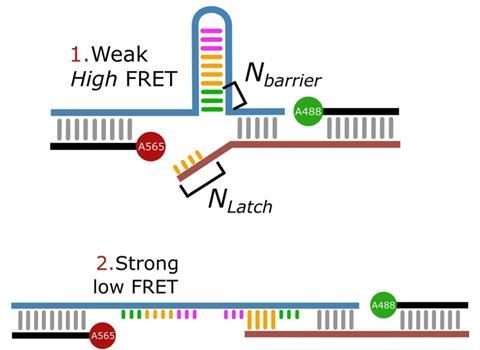
‘The complication was that our synthetic catch bond is somewhat weaker than those found in biology. That is why we had to turn to multivalent systems in order to measure it.’ Albada gives the example of a gecko clinging to a wall. ‘Van der Waals forces in a gecko’s foot are not strong enough on a one-to-one basis either; they only become functional when acting collectively, and the same holds true for the catch bond.’
The star players in this research were PhD candidate Martijn van Galen and master’s students Taieesa Peshkovsky and Annemarie Bok. Albada says: ‘It was an enormously varied project, but Martijn got to grips with all of it. Programming, building computational models, organic and surface chemistry, constructing complex setups, writing analysis scripts. He really did a fantastic job. At the same time, the contributions of Annemarie and Taieesa were equally crucial. They carried out the negative controls using so-called slip bonds, which behave in a more classical manner. During those controls, they discovered that in a macroscopic system you shouldn’t be looking at force–lifetime, but rather at the behaviour of the beads. Martijn then reanalysed the earlier measurements, and suddenly all the pieces of the puzzle fell into place. You genuinely need multiple people to find the right angle.’
Ideal bonds
To top it all off, they also discovered so-called ‘ideal bonds’. ‘That was a genuinely pleasing bonus,’ says Albada. ‘Between the catch bonds and the slip bonds, we observed properties consistent with the ideal bond — one that always has the same interaction regardless of external forces. Unfortunately, due to a lack of funding we weren’t able to develop this further, but since we knew others were also searching for it, we nevertheless staked our claim, and it has held up.’
‘Now that we’ve discovered how to make them, the real excitement begins,’ Albada continues. ‘You can fine-tune the catch bonds, give them different configurations, and start exploring applications.’ Together with colleagues, he is already thinking about materials that exhibit a certain fluidity under normal mechanical stress, but become stiffer rather than weaker as that stress increases. ‘Hydrogels are a good example. DNA is already being incorporated into them for applications such as drug release. If you want to use something like that in the body, it needs to stiffen when force is applied, but not permanently.’
According to Albada, what matters most in projects of this kind is having a talented all-rounder. ‘You need someone who keeps pushing forward, who isn’t afraid of new challenges and has the energy to try new things. Only with that combination of commitment, skills, and talent can you see something like this through to the end. We came close to giving up on several occasions, but we kept believing in what we had.’
Van Galen, M. et al. (2024) Nat. Chem. DOI: 10.1038/s41557-024-01571-4


Every Wednesday in your inbox: the latest chemistry and life sciences news from the Netherlands and Flanders, plus analyses, background stories and more!


No comments yet
Only registered users can post comments on this article.
Log in or register to comment.