


Reaction Disclaimer

A major problem in diagnosing dementia is that the diagnosis is often made too late. By the time memory loss is detected, most of the brain damage has already been done. The leading hypothesis for the cause of dementia and other neurological degenerative diseases, including Parkinson’s and Huntington’s, is the formation of so-called amyloid fibrils in the brain. These are thin, fibrous protein clumps that can grow silently for years without a patient being aware of it. This type of early change can barely be mapped using existing techniques.
That may now be about to change. Researchers from the group of biochemist Stefan Rüdiger at Utrecht University have, together with international colleagues, developed a new measurement method that makes the growth of amyloid fibrils visible.
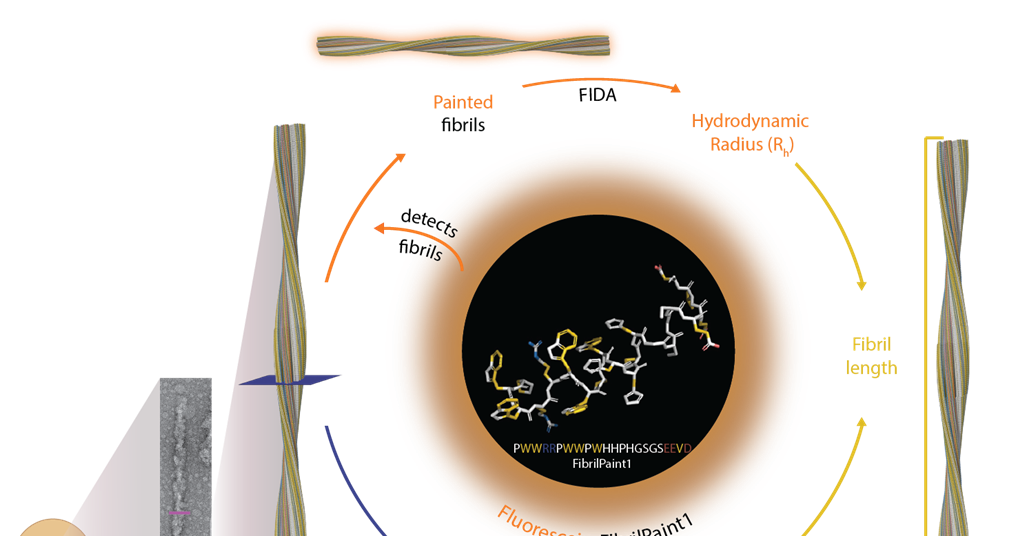
The technique, FibrilPaint, consists of a specially designed fluorescent peptide that binds to the protein threads with high affinity – effectively ‘painting’ them. This makes it possible to directly measure blood or cerebrospinal fluid from patients for the presence of fibrils.
‘Almost all the central proteins in various neurodegenerative diseases, from Alzheimer’s to Huntington’s, form amyloid structures,’ says joint first author and biochemist Júlia Aragonès Pedrola of Utrecht University. ‘Because FibrilPaint does not bind to a specific protein but to the fibrils themselves, it can be deployed for all of these conditions.’
Measuring molecules
Originally, Rüdiger and colleagues were working on an entirely different question: how certain proteins, known as molecular chaperones, counteract the aggregation of amyloid fibrils in a healthy brain. To investigate this, he sought a technique to measure the length of the fibrils. He eventually came across a recently developed microfluidic capillary device, FIDA, which can quantify the length of molecules. ‘That technique seemed perfect to us,’ says Rüdiger. ‘Though we faced the problem that it could only measure fluorescent molecules. So we set about developing a fluorescent peptide that would bind exclusively to the fibrils and nothing else.’
Amyloid fibrils consist of stacked threads of a repeating protein. The researchers successfully designed a fluorescent peptide that attaches solely to these threads, leaving monomers and other aggregates undisturbed. Precisely how it does this remains an open question. ‘Although we have measured that FibrilPaint binds to the fibrils with nanomolar affinity, we do not yet have a picture of exactly how it binds,’ says Rüdiger. ‘We expect that the peptide bridges the stacked layers and binds to multiple threads simultaneously, which would account for the relatively high affinity.’
Sifting through peptides
Together with international colleagues, the Utrecht researchers developed and synthesised the peptide. ‘First, we screened a large set of candidate peptides to determine which bound best to amyloid fibrils,’ says joint first author and biochemist Françoise Dekker of Utrecht University. ‘We did this using Thioflavine T [ThT, ed.], a dye that produces a signal dependent on the growth of amyloid aggregates. When a peptide binds to the fibrils, it influences the ThT signal.’
Using this approach, the researchers defined a subset of four peptides capable of binding to various neurodegenerative proteins, including the tau protein, which plays a major role in Alzheimer’s disease. Through further optimisation steps aimed at measuring fibril length as accurately as possible, they arrived at the best candidate.
Clinical validation
Meanwhile, the researchers are working hard to bring FibrilPaint into the healthcare sector. Dekker is now CEO of a start-up, NeuroTidal Diagnostics, which aims to apply the measurement method in clinical studies seeking treatments for dementia. Dekker: ‘We are currently screening a large cohort of patient samples with FibrilPaint.’
Beyond diagnosis, the peptide paint may also prove useful as a therapy. It also functions as a molecule that recruits the cellular degradation system to clear a specific protein (PROTAC). ‘After FibrilPaint binds to amyloid fibrils, it can signal the cell’s machinery to break them down,’ says Aragonès Pedrola. ‘Although we are still in the process of validating whether this degradation succeeds, we have already demonstrated that the signalling works.’
Aragonès Pedrola, J., Dekker, F.A. et al. (2025) PNAS 122(44), DOI: 10.1073/pnas.2502847122


Every Wednesday in your inbox: the latest chemistry and life sciences news from the Netherlands and Flanders, plus analyses, background stories and more!


No comments yet
Only registered users can post comments on this article.
Log in or register to comment.