






Reaction Disclaimer

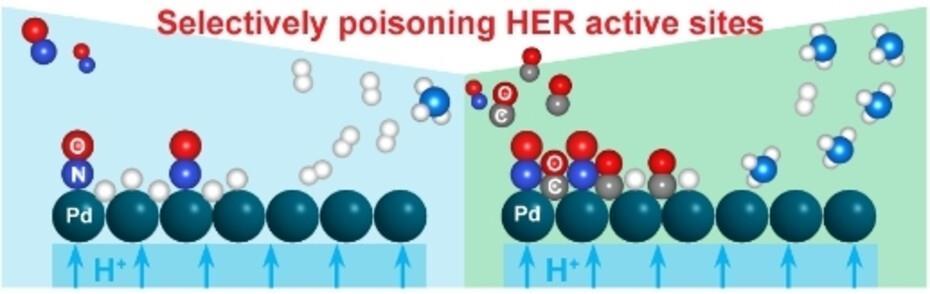
A catalyst that performs better by partially poisoning its surface? That is precisely what a group of researchers from TU Delft managed to achieve. They were working on the reduction of NO to NH3 in a polymer electrolyte membrane cell (PEM), in which Cu/C, Pd/C and Pt/C, among others, function as catalysts. NO reduction in this system is in competition with the hydrogen evolution reaction (HER). When they added CO to the feed, however, it proved to poison the surface in such a way that it selectively suppresses the HER, thereby increasing the efficiency towards NH3. They published their results in early August in ChemSusChem.
Ammonia is one of the most widely produced inorganic substances in the world. Approximately 80% of it ends up in artificial fertiliser, making ammonia an essential substance for the global food supply. We currently produce ammonia via the Haber-Bosch process, which requires high temperatures and pressures. An alternative production process, ideally based on green electricity, would save considerable energy and reduce CO2 emissions. Direct electroreduction of NO to NH3 is, according to the researchers, highly promising, not least because the process can operate continuously.
Cu/C was initially the most active catalyst for NO electroreduction, with a so-called Faradaic efficiency of 78% at 2.0 V. Pd/C and Pt/C had a higher efficiency towards hydrogen. In general, the HER dominated at high cell potentials. When CO was added to the feed, the efficiency towards hydrogen was considerably lower for all catalysts, as CO binds competitively and selectively to the active sites for the HER. This effect was greatest for Pd/C. As a result, the surface coverage of NO improves, causing the efficiency towards NH3 to increase.
Li et al. (2023) ChemSusChem https://doi.org/10.1002/cssc.202300949


Every Wednesday in your inbox: the latest chemistry and life sciences news from the Netherlands and Flanders, plus analyses, background stories and more!


No comments yet
Only registered users can post comments on this article.
Log in or register to comment.