




Reaction Disclaimer

Chemistry is in many cases an ‘invisible’ affair: reactions between molecules are often impossible to observe directly. But sometimes that is possible – at least indirectly – at the macroscopic level. ‘I had posted a video of our research on LinkedIn and it was viewed an absolutely enormous number of times’, says Peter Korevaar, assistant professor of physical organic chemistry. ‘It’s tremendously satisfying to make chemistry visual in five seconds. As a chemist, you’re accustomed to relying on NMR or other indirect methods, but in our case you can actually see what’s happening.’
Korevaar’s group works on the self-organisation of chemical systems at the meso- or macroscopic level. ‘We are intrigued by life, and so we also try to create life-like materials using relatively simple molecules and well-known chemical reactions. How do physical-chemical principles such as surface tension or osmosis bring about that self-organisation, including in such a way that you can observe movement with the naked eye?’
Prey-predator pair
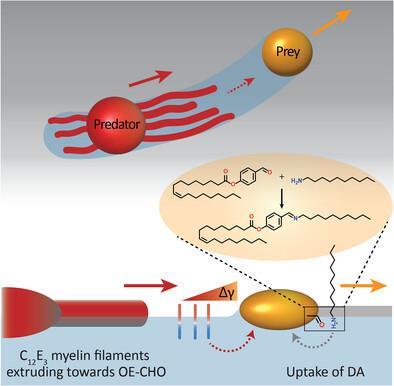
PhD candidate Priyanshu Singh, who put flesh on the bones of this project, discovered this moving system by accident, according to Korevaar. ‘We applied a decylamine layer to a water-air surface, but it crystallised unintentionally. We then saw oil droplets moving through that layer and thought: what’s going on here and can we manipulate it?’ According to Korevaar, you can draw a comparison with a white blood cell chasing a bacterium. ‘It’s quite amusing to “accidentally” recreate something like that synthetically using very simple molecules. It is rather emblematic of much of the research in my group.’
It did take a while before they understood precisely what was happening, but it turned out that an oil droplet bearing an aldehyde group, which they introduced, reacted with the decylamine and gradually ‘consumed’ portions of it. When a second ether-based droplet is then added, it follows the trail left by the first droplet through the decylamine layer, allowing the two droplets to be viewed as a kind of prey-predator pair.
Knobs
‘The greatest obstacle we then faced was coordinating all those interactions with one another’, explains Korevaar. ‘You want to prevent the prey droplet from moving far too slowly or too quickly. The predator must follow behind it, and that too must happen at the right speed.’ In the end, they succeeded in gaining control over all those parameters.
With this fairly fundamental research, Korevaar aims to map out how things observed in living systems can be achieved using inanimate molecules. ‘You can come up with ideas on paper, but by doing it experimentally as well, you can see which knobs you need to turn and which reactions you require. That’s also where you see the strength and creativity of Priyanshu – he thought very carefully about which reactions you can use to propel that droplet across such a crystalline surface.’
Chemical computer
In follow-up research, Korevaar wants to take steps towards cascades. Korevaar: ‘How wonderful would it be if, when droplets encounter one another, they react with each other and trigger a new effect in turn?’
But the scope could be even greater: imagine a field containing an enormous number of those droplets. Each droplet would then form an input in a system. ‘The resulting movement of the combined droplets would constitute a superposition of all those chemical inputs you have entered’, explains Korevaar. ‘You can think of it as a chemical computer that not only performs computations, but also immediately brings about something as a consequence of that computation.’ Whereas a conventional computer operates with bits and bytes, self-organisation becomes the programming language in this case. ‘That is truly one of the practical possibilities – not merely creating a chemical programme in silico, but also “in materia”.’
‘You can imagine that in such a system you would need to couple typical chemical reactions to real diagnostic reactions you wish to carry out, such as couplings to proteins, DNA and so forth’, Korevaar continues. ‘Those are steps that come later, which we need to think through further. But once you have the physical chemistry firmly under control, you can truly take new steps forward.’
Singh, P. and Korevaar, P.A. (2025) Angew. Chem. Int. Ed. e202502352, DOI: doi.org/10.1002/anie.202502352


Every Wednesday in your inbox: the latest chemistry and life sciences news from the Netherlands and Flanders, plus analyses, background stories and more!


No comments yet
Only registered users can post comments on this article.
Log in or register to comment.