



Reaction Disclaimer

That we collectively produce, consume and throw away an enormous amount of plastic and clothing is clear. But what do we then do with that gigantic mountain of waste? ‘For high-grade plastics, such as PE or PET, there are good methods of recycling,’ says Jan Jaap Folmer, CEO and co-founder of start-up UPPACT in Delfzijl. ‘But unfortunately around 70 per cent of plastic and textiles end up on landfill sites or in the incinerator. This is largely because in most cases it is difficult to separate and sort waste and then make it suitable for reuse.’
What if you were to stop trying to separate this seemingly unusable waste, and instead start mixing it? And in such a way that an almost homogeneous mass is created from which high-quality building materials can be made? That is precisely what UPPACT does with its patented mixer-melter. Folmer: ‘We were surprised at how efficiently this UnWasting, as we call it, works in practice.’
The melting and mixing of plastic waste is done elsewhere, but existing machines are often inefficient, according to Folmer. ‘They mostly operate on the basis of a single specific temperature. That is not optimal, because different plastics have varying melting points. At 200 degrees Celsius, one type may already be burning or degrading, whilst another type is barely liquid. This means the whole mixture does not blend properly.’
‘Under specific pressure and friction, different polymers exhibit comparable behaviour’
Jan Jaap Folmer
With the UnWastor, UPPACT takes an entirely different approach. ‘We do not mix on the basis of temperature but on the basis of the same plasticity of the various materials. Under specific pressure and friction, different polymers exhibit comparable behaviour. This makes the mixing process highly stable and gives us a consistent substance.’
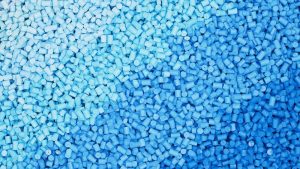
This substance is then pressed into the shape of posts and planks via an extruder. ‘If you saw through the plank, you see a nice, even cut surface with no trace of the different materials it is made from,’ says Folmer. ‘But most importantly, these UnWasted products are eminently suited for civil engineering works in ground, road and water construction. Think park benches, decking paths, earth retaining structures and sheet piling.’
The advantages are evident, Folmer continues. ‘Whether it is contaminated food packaging, discarded trainers or agricultural plastic fouled with sand: the UnWastor processes it all. The material does not need to be shredded, sorted or washed beforehand. This significantly reduces the energy footprint compared with traditional recycling methods. Moreover, the end products are fully recyclable, which closes the loop.’
A ‘cool’ machine, then. And one that owes its existence to inventors from the perpetually warm Down Under. ‘The company PlasTech Recycling Limited had already built the first prototype of the mixer-melter over 10 years ago,’ explains Folmer. ‘But the Australian market was not yet ready for this form of recycling at the time. I was asked to investigate the possibilities in the Netherlands.’
‘We had to adapt the machine to the Dutch climate’
Michel Walstock
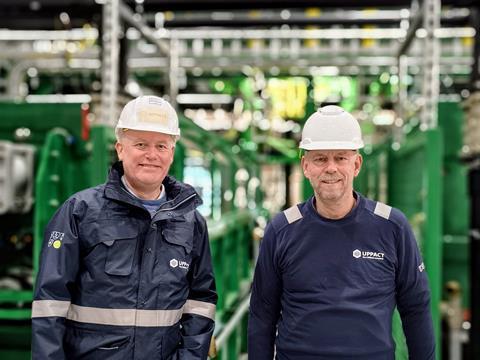
Folmer, who has been active in the recycling industry for years, was initially sceptical. ‘But when I saw the machine in operation, I was convinced. It simply did what had been promised.’ Together with Michel Walstock, UPPACT’s current CFO, he decided to bring the technology to the Netherlands. Last June, the prototype arrived in a container at the Eemshaven.
The technical process ran almost immediately without a hitch, although minor adjustments were needed for the Dutch climate. ‘It is cooler and more humid here than in Australia,’ says Walstock. ‘We had to shield the machine better against draughts and moisture. We also learnt that if we allowed the mixture to cool too quickly, the machine could seize up due to solidifying plastic.’
Since the beginning of this year the demonstration machine has been operational, though not yet quite at full speed. ‘The ambition is to reach an annual volume of 4 million kilograms of UnWasted by the end of 2026,’ says Walstock. In the future, the team also wants to develop other product forms, such as sheet material. ‘To achieve that, we will continue to develop and fine-tune the technology.’
At present, sales of the building materials produced are getting well under way. There are therefore well-founded hopes for further growth. But where will UPPACT be in 10 years’ time? Will there be dozens of UnWastors distributed across Europe at local waste processors? ‘That could very well happen,’ answers Walstock. ‘We are convinced that this technology can play a key role in solving Europe’s waste problem.’
Accelerating in biopharma: starting out at Pivot Park
For aspiring entrepreneurs in the biopharmaceutical sector, the Pivot Incubator programme offers an ideal springboard. Start-ups gain access to fully equipped laboratories, flexible office space and a starter package with essential equipment. In addition, there is personal guidance, access to experienced mentors and a powerful network of experts and investors. Community events and knowledge sharing foster collaboration and growth from day one.
Interested in starting your initiative at Pivot Park? We are happy to explore how Pivot Incubator can add value for you.
Pivot Park in Oss is the premier hub for companies and knowledge institutions in the biopharmaceutical industry. On this campus, over 1,000 professionals work across some 65 start-ups, scale-ups and established companies. Pivot Park is more than a location: it is an ecosystem where innovation and entrepreneurship converge – a place where the healthcare of tomorrow is being built.



Every Wednesday in your inbox: the latest chemistry and life sciences news from the Netherlands and Flanders, plus analyses, background stories and more!


No comments yet
Only registered users can post comments on this article.
Log in or register to comment.