




Reaction Disclaimer

When it comes to innovation, universities and higher education institutions are quickly associated with being the source of new insights and discoveries. ‘But it is often vocational college students who put these innovations into practice’, says Rianne Veldt-Meijer, practor of Bio Sciences and lecturer in Intermediate Laboratory Education at mboRijnland. ‘Vocational students have a hands-on mentality, and in the work they do, they translate university and higher education innovations into practical applications.’
Veldt-Meijer sees in her lessons and projects that vocational students are very well suited to research because of their creativity and critical attitude. ‘When higher education students develop an analysis, my students get to work with it: measuring large quantities of samples and critically examining the analyses.’ Something else that is frequently overlooked is the large number of small innovations that find their origins precisely there.
‘In this way, you create learning environments that prepare them for real life’
She gives as an example a student who had carried out some analyses at his placement company. ‘By optimising the method here and there, the results of those analyses improved considerably. That kind of small innovation is extremely important, but not particularly spectacular or visible.’ Since 2023, Veldt-Meijer has been working as a practor (‘professor or lecturer of the vocational college’) and is part of the Centre for Innovative Craftsmanship (CIV) Bio Sciences. ‘As a practor, you conduct practice-based research, in which we aim to connect the professional field with education.’
Great tit
In this way, the practorate collaborates with, among others, the horticultural company Delphy. Samples are received by the students and measured for the company using analytical equipment based at the school. ‘Through this, they learn the analytical techniques and at the same time deliver valuable data directly to the professional field. We use this to try to instil an even stronger enquiring attitude in our students.’
Another example of student research is the collaboration with the practorate Water and Soil at the Blauwe Hotspot Water, Bodem en Klimaat and Yuverta, a ‘green’ educational institute for secondary vocational education. Students on Yuverta’s liveable city and climate programme collect water and soil samples from local farmers or from a particular neighbourhood. On the basis of analyses, they then provide advice on fertilisation or planting. ‘Previously, they looked only at the qualitative data they determined themselves using simple equipment, but we now supply the quantitative data, which means there are more parameters and measurements can be taken more accurately. This allows the advice to be better aligned with the measurements’, says Veldt-Meijer.
The ‘Meet de mees’ project from the Analytical Biosciences research group at Hogeschool Leiden is also receiving assistance from a vocational college placement student. This citizen science study uses the great tit as a biomonitoring tool for the spread of pesticides, and to that end, with the help of members of the public, they collect unhatched eggs and dead young great tits that remain after the breeding season. ‘Lots of data, lots of samples that need to be analysed — ideal for vocational students to gain experience on a socially relevant project.’
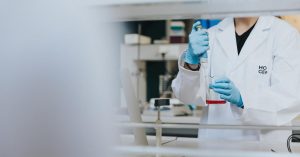
GMP lab
Veldt-Meijer explains that under the banner of the CIV, students from the laboratory programme at mboRijnland take part in a Good Manufacturing Practice (GMP) training week. This is provided by the Biotech Training Facility and Johnson & Johnson Innovative Medicine, both of which are CIV partners in Leiden. ‘This allows students to immerse themselves in how you work in a GMP lab, how you dress, why that matters, and so on. From the school environment, they genuinely go out into the field. In this way, you create learning environments that prepare them for real life.’
She hopes that this approach will also raise the profile of vocational students. ‘I would love for people to start recognising the value of vocational students, because they are still so often overlooked.’ To that end, she wants to set up projects in which university, higher education and vocational college students work together in an interdisciplinary manner, rather than the small, isolated steps through which vocational education is currently involved. ‘It needs to be taken more seriously. I genuinely believe that the practical skills of vocational students can be a valuable complement to the theoretical knowledge of those from higher and university education.’


Every Wednesday in your inbox: the latest chemistry and life sciences news from the Netherlands and Flanders, plus analyses, background stories and more!


No comments yet
Only registered users can post comments on this article.
Log in or register to comment.