








Reaction Disclaimer

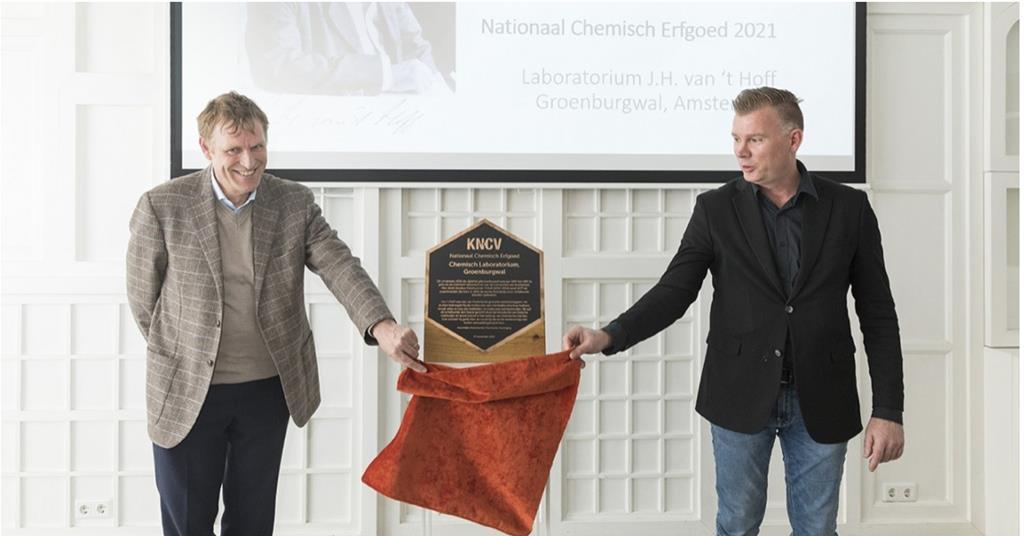
This building, which is currently used as a café and exhibition space, served as the chemistry laboratory of the University of Amsterdam from 1857 to 1891. It was here that Jacobus Henricus van ‘t Hoff (1852–1911) conducted, from 1877 onwards, the experiments that would earn him the first Nobel Prize in Chemistry in 1901. He laid the foundations of stereochemistry, in which he considered molecules in three dimensions. He received the Nobel Prize, however, for thermodynamics, through his research into osmosis.
Prior to the unveiling, Ernst Homburg (former chairman of the CHG) took visitors on a journey back in time, offering a glimpse into a number of historic laboratories. These were often connected to a botanical garden, though existing buildings were also regularly converted into laboratory spaces, as was the case with the building on the Groenburgwal.
Rob van den Berg (secretary of the CHG) went on to explore the life of Van ‘t Hoff in greater depth. Van den Berg devoted his doctoral research to writing a biography of Van ‘t Hoff, ‘Een gedreven buitenstaander’ (‘A Driven Outsider’), published by Prometheus.
The plaque was unveiled by KNCV chairman Jeroen Cornelissen and Wybren Jan Buma (scientific director of the Van ‘t Hoff Institute for Molecular Sciences (HIMS) at the University of Amsterdam), in the presence of the current owners Renny and Leon Ramakers.
Each year, the National Chemical Heritage committee designates a location as a ‘Chemical Landmark’. You can help by nominating a location that you consider to be of historical significance!


Every Wednesday in your inbox: the latest chemistry and life sciences news from the Netherlands and Flanders, plus analyses, background stories and more!


No comments yet
Only registered users can post comments on this article.
Log in or register to comment.