



Reaction Disclaimer

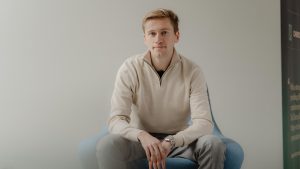
Thanos Fokaidis-Psyllas

Completed his bachelor’s degree in chemistry in Greece and is now pursuing a master’s programme at Ghent University.
‘When I was finishing my bachelor’s degree, I was looking for interesting research groups. I came across the laboratory of Professor Filip Du Prez. I applied and this coming semester I will be doing my master’s internship in his PCR, Polymer Chemistry Research, group. My research will focus on developing thermoset-like materials that are reusable and recyclable. I intend to do this by making use of a new chemistry platform based on reversible covalent bonds.
Coming here to study was not an entirely easy experience. The weather in particular came as a great shock, with the rain and the very short days during autumn and winter. The master’s programme also turned out to be quite time-intensive, with all the assignments and modules. But I am gradually finding my feet and the coming academic year will be much better. I hope to complete my master’s degree and then begin doctoral research here — perhaps in the same group, as it is a wonderful environment with many talented and professional researchers. For international students considering continuing their education here in Belgium/Ghent, I would absolutely recommend it. The standard of the modules is very high and the career prospects are excellent. You may experience a degree of culture shock at first, but ultimately it is worth it.’
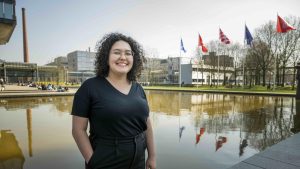
Fatemeh Latifi
Studied Textile Engineering in Iran and obtained her master’s degree in chemistry at the University of Antwerp. She now works as a researcher at Agfa-Gevaert in Mortsel.
‘I discovered that the chemical industry is very strong in Belgium, which is why I decided to do my master’s degree here. That proved to be an excellent choice — the modules were varied and the lecturers were very kind and gave me a great deal of support during classes. There were of course certain challenges, particularly because I was in Belgium during the Covid pandemic. It was difficult at the time to get to know the city and the university. During the first two semesters I also had little opportunity to make friends in my class. But things improved later on.
There are a few differences in chemistry education between Belgium and Iran. In my home country, a master’s programme is often research-based, whereas in Belgium it is more course-based. In Iran, students have the opportunity to publish based on their master’s dissertation. In Belgium, however, I had the chance to delve more deeply into a range of subjects. I am now a junior researcher in the R&D department at Agfa-Gevaert, where I research ink formulations. I am keen to continue working in the chemical industry in Belgium.’


Every Wednesday in your inbox: the latest chemistry and life sciences news from the Netherlands and Flanders, plus analyses, background stories and more!


No comments yet
Only registered users can post comments on this article.
Log in or register to comment.