


Reaction Disclaimer

At the mere thought of prussic acid, or hydrogen cyanide (HCN), alarm bells are sure to start ringing. It is, after all, an extremely toxic gas, yet at the same time an essential ingredient in the production of the important amino acid methionine. Degussa, one of the predecessors of the current Evonik, succeeded in producing methionine on a large scale from acrolein, methyl mercaptan and hydrogen cyanide shortly after the Second World War.
Initially, it was brought to market as a medicine to treat hunger oedema resulting from a lack of proteins — a widespread problem in the years following the Second World War. From the 1950s onwards, demand for methionine as an ingredient in animal feed grew considerably; it is a particularly important component in poultry feed. In 1974, Degussa opened a methionine plant in Antwerp. Since then, capacity has increased more than twentyfold: from 12,000 tonnes to 260,000 tonnes per year. It is now the second-largest methionine plant in the world, after Evonik’s site in Singapore. Coinciding with the fiftieth anniversary, Evonik obtained a new open-ended operating permit for the Antwerp site.
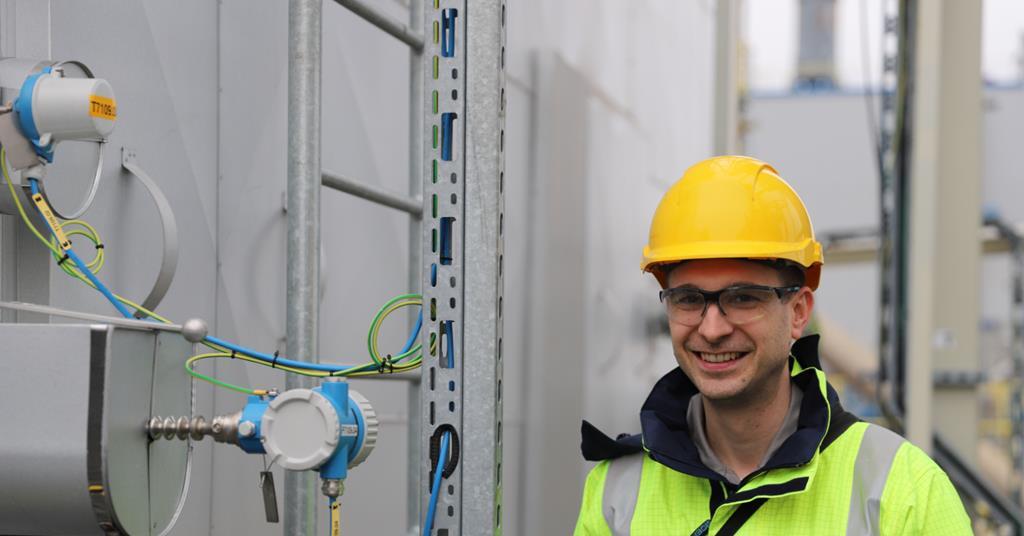
One of the conditions attached to that new permit was the reduction of NOx emissions from hydrogen cyanide production. Project manager Karl-Georg Fey explains that this concerns the reduction of nitrogen oxides in the flue gases from the steam boilers. ‘Hydrogen cyanide is produced by reacting methane and ammonia at high temperatures. In a first step, natural gas is purified to obtain pure methane. The residual gases are combusted and provide the necessary heat for the reaction. The resulting flue gases are subsequently passed through a steam boiler to recover heat. The combustion of the residual gases generates nitrogen oxides.’
‘The new selective catalytic reduction unit ensures that the remaining 20 per cent of NOx is converted by a further 85 per cent’
Karl-Georg Fey, Evonik Antwerp
The process already incorporated a step to prevent a large proportion of the NOx from entering the atmosphere. The hot flue gases react in the flue gas duct with atomised ammonia to form nitrogen and water. This so-called selective non-catalytic reduction (SNCR) requires the flue gases to be at a high temperature of around 900 °C. This reduces NOx emissions by approximately 80 per cent. A portion of the residual heat from this process is recovered via the steam boiler. The flue gases at the outlet still have a temperature of 300 °C. At this temperature, the reaction between nitrogen oxides and ammonia requires a catalyst. ‘The new selective catalytic reduction, or SCR unit, ensures that the remaining 20 per cent of NOx is converted by a further 85 per cent.’ Heat is also recovered from the residual stream, after which the temperature of the flue gases ultimately drops to around 140 °C.
Installing the new SCR unit was relatively straightforward, as space had already been set aside during the construction of the steam boiler in 2012 for a potential additional flue gas treatment system. Fey: ‘We built this installation to meet the new emissions requirements. Despite the scale of the project, the execution was relatively straightforward. It was a considerable advantage that there was sufficient space to install the unit and make the connections.’ Finding a suitable supplier, however, proved to be a genuine challenge. ‘This type of catalyst unit is normally used in gas-fired power stations — installations with far larger combustion systems than our steam boiler. Designing such a small unit was something new for most suppliers. One company proposed delivering the components separately, like an Ikea flat-pack. In the end, we did manage to find a supplier who could provide us with a compact unit.’
The new unit was installed during the three-week maintenance shutdown of the hydrogen cyanide plant. There was a moment of uncertainty as to whether the installation of the catalyst would go smoothly. ‘We were keeping our fingers crossed for dry weather — the catalyst blocks must not get wet.’ The start-up proceeded without any issues, although the control of the installation did prove challenging, according to Fey. ‘You have to find a balance between the quantity of ammonia being atomised and the NOx content in the emissions. If too little ammonia is added, too many nitrogen oxides escape into the atmosphere. But too much ammonia must not be atomised either, since we obviously do not want to emit that into the air.’
The hydrogen cyanide plant in Antwerp comprises two production units. Later this year, Evonik will also install a catalyst block in the second unit. Fey anticipates that this job will be more complex. ‘There is considerably less space available in this installation.’ For this reason, the installation of the catalyst unit in the second production facility will take place in two stages. ‘There are two planned maintenance shutdowns this year. We will use the first stop in May to create space — we need to relocate some equipment. During a second shutdown, we will then be able to install the new catalyst unit.’
That will be a major undertaking. ‘Because the gases involved are at high temperatures, the pipework has a large diameter — sometimes up to one and a half metres. To accommodate it, existing equipment that has nothing to do with this unit will need to be relocated. That means all the connections and electrical provisions will have to be moved as well.’ Once Evonik completes this puzzle too, the methionine plant will be well prepared for its next anniversary.


Every Wednesday in your inbox: the latest chemistry and life sciences news from the Netherlands and Flanders, plus analyses, background stories and more!


No comments yet
Only registered users can post comments on this article.
Log in or register to comment.