


Reaction Disclaimer

According to petrochemical giant ExxonMobil, CO2 capture and storage, or Carbon Capture & Storage (CCS), is one of the most important measures for achieving climate-neutral operations by 2050. They also recognise that demand for oil-derived products remains consistently high. ‘We want to continue meeting demand for products whilst simultaneously reducing CO2 emissions’, says Micha Sprengers, Business Planner at ExxonMobil. Wind and solar energy and electrification will not be sufficient for heavy industry to achieve net zero. In 2021, the company established the Low Carbon Solutions (LCS) division to explore what new technology can contribute to reducing industrial CO2 emissions. Sprengers: ‘Developing technology to capture CO2 is a priority within our company, alongside the development of low carbon fuels and the application of hydrogen.’
Proven technology is available to capture CO2 from industrial processes. ExxonMobil itself has been working on the development and improvement of such processes for over a decade. But the innovation that ExxonMobil has been developing with Fuel Cell Energy since 2016 could deliver a significant reduction in costs and energy consumption, Sprengers explains. ‘FuelCell Energy originally developed the carbonate fuel cell, CFC, to generate electricity. Currently, around 220 MW of electricity is being generated worldwide using the company’s CFCs. Through a joint research programme, we have adapted the technology to use it for capturing CO2 from industrial installations. In addition to capturing CO2, it also releases hydrogen, electrical energy, and heat, which we can put to use as well.’ These valuable by-products mean the technology potentially comes with significantly lower costs. ‘Affordability of the technology is essential to enable widespread application. Once you can apply technology broadly, you start making real headway in terms of emissions reduction’, concludes Sprengers.
The CFC utilises the electrochemical principle of fuel cells. In a conventional fuel cell, hydrogen and oxygen are converted into water and electricity under an electrical voltage between anode and cathode. In FuelCell Energy’s carbonate fuel cell, the residual gases containing CO2 are fed in at the cathode. There, CO2 is converted into carbonate ions. These then flow towards the anode. At the anode, the carbonate ions react with hydrogen to produce CO2 and water once more. The hydrogen required is formed through a steam reforming reaction of methane with steam at the anode. The result of this process is that the outgoing CO2 stream is highly concentrated and therefore easier to separate. Energy is released during the process in the form of heat and electricity. And that is a significant advantage over conventional CO2 capture methods, Sprengers explains. ‘CO2 capture based on amines, for instance, consumes a great deal of energy.’
‘Once you can apply technology broadly, you start making real headway in terms of emissions reduction’
Micha Sprengers
The CFC system has been tested at laboratory scale. In Rotterdam, the process is being deployed at industrial scale and under real industrial conditions for the first time. ‘We are constructing the installation at the hydrogen plant on our site in the Botlek. We will use it to capture a portion of the flue gases.’ The quantities of CO2 involved are not large for the time being, according to Sprengers. ‘For our pilot test, we are deploying two modules, each the size of a shipping container. With these, we can capture around 10 kilotonnes of CO2 per year. We want to demonstrate the performance of the process in practice and at greater scale. In a laboratory, you test a process with constant and conditioned streams and conditions. In a real-world situation, the composition will fluctuate, and we want to know how the capture process responds to this. Is the installation robust under plant conditions? How does the installation respond to interruptions in the power supply or when another part of the plant fails? What is the performance over an extended period?’ The pilot will run for five years. The results are important for informing a decision on further scale-up and application in other installations. Sprengers: ‘This technology can be used broadly — think of equipment such as furnaces, steam boilers, and cogen units [cogeneration units, or combined heat and power, Ed.]. But also in other sectors such as the steel or cement industry, in ammonia production, or in electricity generation.’
[Read on below the illustration]
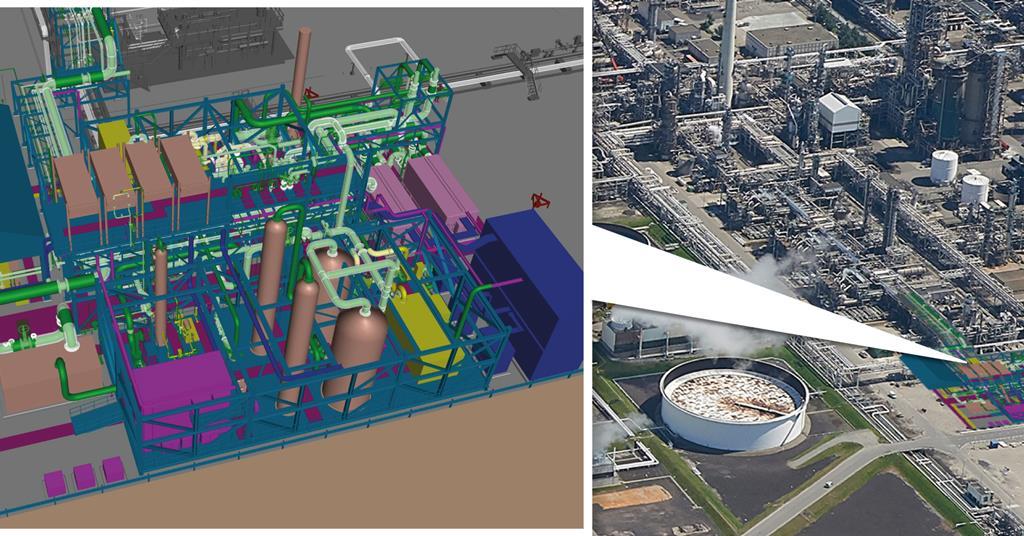
According to Sprengers, the parent company’s decision to build the pilot in Rotterdam was driven by several reasons. He first cites the development of the transport and infrastructure for the CCS project Porthos. ‘ExxonMobil is one of the four parties that will make use of Porthos when the project is completed in 2026. This makes it possible for us to test the full value chain, from CO2 capture through to storage beneath the North Sea bed.’ A further factor is that the refinery ‘is a frontrunner in Europe when it comes to energy efficiency’, according to Sprengers. ‘In Rotterdam, we are working on various initiatives to reduce CO2 emissions. Since the 1980s, we have been investing extensively in heat integration and energy conservation within the company — for example, preheating air streams before they enter the furnaces. We also exchange residual heat with nearby companies in the Port of Rotterdam.’ The company is additionally exploring opportunities to use more hydrogen in place of natural gas, to electrify processes, and to employ alternative feedstocks (biobased or chemically recycled plastics).
‘In addition to capturing CO2, it also releases hydrogen, electrical energy, and heat’
Micha Sprengers
Another important reason for choosing Rotterdam was that the project qualified for financial support. ‘Building a demonstration plant to test the technology at small scale in an operational environment is extremely costly. We are therefore very grateful for the support from the European Innovation Fund and the grant from the Demonstration Energy and Climate Innovation scheme of the Netherlands Enterprise Agency.’ Preparatory work for the construction of the installation began during a recent maintenance shutdown. Sprengers: ‘All connections to the existing equipment have been installed and the site has been prepared for construction.’ The installation will be built off-site. The modules will be transported to Rotterdam by ship. ‘We have a fairly small site where space is limited. For safety reasons, installations are increasingly being built at specialist construction yards before being installed on site.’ The intention is for the installation to be commissioned in 2026.


Every Wednesday in your inbox: the latest chemistry and life sciences news from the Netherlands and Flanders, plus analyses, background stories and more!


No comments yet
Only registered users can post comments on this article.
Log in or register to comment.